
When surgeons wear AI: how neuroadaptive systems are transforming the operating room
Tuesday, July 28, 2026
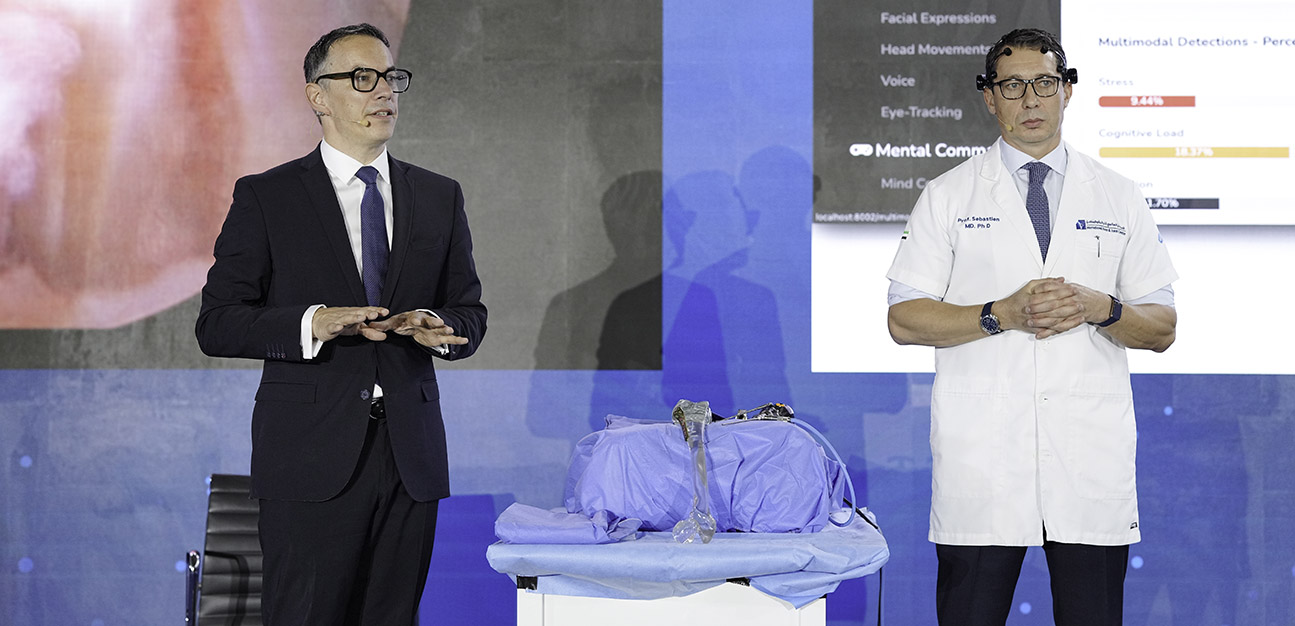
On 8 July 2026, Olivier Oullier, professor of human-computer interaction at MBZUAI’s Computing and Mathematical Sciences Division, represented the University at the United Nations’ AI for Good Summit in Geneva, Switzerland, during a special session on brain-computer interfaces (BCIs). He presented a neuroadaptive AI solution, developed with Sébastien Parratte, professor of orthopedic surgery at the Institute for Locomotion, Aix-Marseille University and orthopedic surgeon at the International Knee and Joint Center in Abu Dhabi, that monitors a surgeon’s stress, attention and cognitive load in real time during live surgery.
Burnout among surgeons is no longer a hidden problem. It is measurable, widespread, and directly associated with poorer patient outcomes, as a substantial body of scientific and medical literature shows. Against this backdrop, Oullier and Parratte have spent years building a system to give surgeons insight into what is happening inside their own bodies and brains while they operate, and to help them manage that load.
A surgeon’s wake-up call
They first presented the work together at MBZUAI’s AI Innovation Day for Health, on 12 November 2025, in a conversation that anchored one of the event’s live demonstrations.
At the event, Parratte shared the moment that changed his life and his approach to medicine. “Over the past 20+ years, I’ve done more than 15,000 orthopedic surgeries,” he said, “and one day, I woke up in a hospital bed.”
He described a picture from 2017, showing him on bedrest after he suffered a cardiac arrest. “It took this life-changing event for me to realize I was overstressed, doing too many things all the time,” he said. “And I thought, maybe I’m not alone in experiencing this.”
He was right. Oullier, a neuroscientist and entrepreneur who develops multimodal neuroadaptive AI systems and previously headed health and healthcare industries at the World Economic Forum, said: “In some instances, up to 47% of surgical residents experience burnout. It is a serious issue for the clinicians themselves but also for patient safety.”
Clinician burnout is also a patient safety issue
The consequences of burnout are not abstract. “If we don’t perform well, patients are not going to do well, Parratte said. “There’s a high risk of complications and a high risk of problems related to stress and fatigue.”
Oullier had measured those demands directly. “In the operating room, there is always something happening: the patient, the environment, people talking, equipment beeping,” he said. “You pay attention to what is happening behind you, looking in front of you, and you must be anticipating so many other things all at once.” That constant multitasking, he added, leads to cumulative cognitive and physical fatigue.
Measuring the invisible in the operating theatre
Parratte and Oullier asked a deceptively simple question: what if surgeons could be informed about what is happening inside their own bodies and brains while operating? “That’s when we started to think about what we could do together to measure, better understand and predict fatigue, stress and cognitive load in the operating room,” Parratte said. Oullier added the second half of the problem: how to present that information to surgeons “in real time, without interfering with their work,” pointing to the role of human-computer interaction and multimodal neurofeedback in the project.
Before the system, surgeons relied largely on self-report, intuition and experience to manage stress and fatigue during complex procedures. The answer came from Inclusive Brains, the company Oullier co-founded, which develops, in partnership with IBM, device-agnostic multimodal AI that can turn any sensor-equipped device into a neuroadaptive system. “We’re using wearables everywhere in everyday life,” Oullier said. “So why not here, in the operating room?”
The patented system integrates data from brainwaves, heart rate, respiration, eye tracking, voice intonation and motion capture, and, during training, facial expression, a modality that cannot be used during surgery because of the masks clinicians wear. “The idea is to provide the AI system with information not only about what is happening in the operating room,” Oullier said, “but what is happening in the surgeon’s body and brain.”
Turning raw signals into insight that can save lives
On their own, neurophysiological signals offer limited insight. “If you use multimodal neuroadaptive AI, suddenly you can detect stress, cognitive load and attention in real time,” Oullier said. The system does not distract surgeons with alarms. “There are no alerts,” he explained, “because alerts could distract the surgeon.” Instead, stress, attention and cognitive load are displayed on a screen outside the surgeon’s field of view, for them to check when they choose to. That design reflects a core principle of the project: AI should augment human decision-making, not interrupt or replace it.
During a live demonstration at our university’s AI Innovation Day for Health, Parratte walked the audience through a simulated surgical task. “There’s an artery two centimeters behind where the needle I’m using is inserted,” he explained. “This is a very stressful phase of surgery.” At moments like that, he relies on absolute attention. “If I have doubts about my ability to focus, I pause,” he said. “I breathe. I re-focus. I make sure nobody is talking in the room. I need 100% of my cognitive capacity.”
The feedback, he said, helps him recognize when he is approaching, or exceeding, his cognitive limits, and gives him a way to train: “When you go to the gym, you use trackers and wearables, and you get better because you have feedback. It’s now the same for surgery.”
The most stressful moment isn’t surgery
One finding that emerged after months of data collection was that surgeons’ peak stress comes after surgery, not during. “Cognitive load of surgeons is high all the time during surgery,” Oullier said. “But their stress level remains relatively low given what is at stake. It’s somewhat similar to what we observed with Formula 1 drivers and top pilots in the army.” Stress rises, he said, when Parratte speaks to the patient or their family afterward. “In surgery, I operate on a knee,” Parratte said. “But outside the operating room, I’m talking to a brother, a sister, or a parent. That’s when the human side comes back. What stresses us is not delivering what we promised to the patient and the family. It’s, once the surgery is over, about what could have gone wrong and the consequences.”
What comes next
After exploratory work with dental surgeons at Biotech Dental Group and during orthopedic surgery at the International Knee and Joint Center, the next step is a scientific study during neurosurgery, once regulatory approval is cleared. “We’re looking forward to deploying this solution further and continuing high-level research,” Oullier said, “and then to develop and deploy products that improve the health and wellness of surgeons and, more importantly, patient outcomes.”
A methodological paper that Oullier and Parratte co-authored with MBZUAI Professors Elizabeth Churchill (human-computer interaction), Cesare Stefanini (robotics), and Florian Roser, chief medical officer at Cleveland Clinic Abu Dhabi, received the best presentation award at the International Conference on Neuroscience and Clinical Applications in May. Roser and Oullier also co-authored the lead article* in the July edition of Clinical Neurology and Neurosurgery, introducing new uses of BCIs and quantum informatics in the operating room.
For Oullier and Parratte, the goal at the United Nations’ event, or in Paris where their innovation was demonstrated live to an audience in June at Vivatech, was the same one that has driven the project since 2023 when they started it in Abu Dhabi: to augment surgeons’ expertise with neuroadaptive AI, reducing risk, improving clinician performance and patient outcomes, and preserving physical and psychological safety.
*Oullier O., Roser R., Barbaste P. & Vasques X. (2026). Improving consciousness assessment through neuroadaptive artificial intelligence and quantum-enhanced brain-computer interfaces. Clinical Neurology and Neurosurgery, 266, 109396, https://doi.org/10.1016/j.clineuro.2026.109396
Related

Creativity on campus: cultivating innovation at MBZUAI
On World Creativity and Innovation Day, we look at what creativity means at MBZUAI, how it is.....
- incubation and entrepreneurship center ,
- Teaching ,
- creativity ,
- mentorship ,
- campus ,
- IEC ,
- faculty ,
- innovation ,
Designing the human side of AI
MBZUAI’s inaugural HCI Symposium explored how people will live and work alongside AI, and how to ensure.....
Read More
AI and the silver screen: how cinema has imagined intelligent machines
Movies have given audiences countless visions of how artificial intelligence might affect our lives. Here are some.....
- cinema ,
- fiction ,
- art ,
- science fiction ,
- AI ,
- artificial intelligence ,