
Creativity on campus: cultivating innovation at MBZUAI
Tuesday, April 21, 2026

Every year on 21 April, World Creativity and Innovation Day highlights the role of ingenuity in human development – celebrating creative thinking as the wellspring of cultural, scientific and technological progress.
At MBZUAI, creativity and innovation are central tenets – embedded in its teaching, research, and entrepreneurship, and shaping how the University’s faculty, students, and staff approach problems and develop ideas.
This environment – designed for scientific discovery, talent development, and real-world impact – allows the MBZUAI community to explore, iterate, and scale ideas that use AI as a global force for good.
“At its core, MBZUAI fosters creativity and innovation by focusing on a dynamic and emerging field that attracts brilliant, innovative, and original thinkers,” says Cesare Stefanini, Professor of Robotics.
“It also encourages interdisciplinary initiatives and collaborations – not only within STEM disciplines but also with the humanities and the arts – and supports entrepreneurship through dedicated programs and activities. Together, this adds up to creative environment that can easily lead to innovative thinking.”
Elizabeth Churchill, Department Chair and Professor of Human-Computer Interaction, agrees that MBZUAI is structured to encourage collaboration across disciplines – something she sees as essential for new modes of thinking.
“Modern creativity and innovation have shifted toward collaborative endeavors,” she says. “Firstly, due to increased social connectivity. And secondly, due to the complexity of contemporary problems that require synthesizing highly specialized disciplines.
“Individual ingenuity is still a critical catalyst, but transformative breakthroughs today typically emerge from the collective intelligence of interdisciplinary teams and their dynamic interactions with advanced computational tools.
“For example, at MBZUAI we focus on innovation by treating AI not merely as a computational science, but as a versatile medium for advancing human-computer interaction and human-centered design. We are intentionally invested in creating human-centered solutions to critical problems such as sustainability, healthcare, and education.
“By encouraging interdisciplinary initiatives that merge rigorous technical research with foundational design principles, the University ensures that future AI systems are fundamentally creative, accountable, and aligned with complex human experiences.”
A hotbed of innovation
This environment has led to a range of innovative papers, projects and initiatives across MBZUAI’s first five years.
Projects such as the PAN world model and reasoning-focused systems such as K2 Think and K2-V2 push beyond static generation toward models that can simulate, reason, and explore possibilities over time. Alongside language models such as Jais, they reflect a shift toward systems that combine knowledge, operate across contexts, and support more creative forms of problem-solving.
Biology, medicine and healthcare are also key areas of innovation. Initiatives such as the Human Phenotype Project and systems such as GluFormer apply AI to complex biological data to enable earlier diagnosis and more precise treatment. Work from the BioMedia Lab and startups such as GenBio AI extends this further, using multimodal data and computational biology to rethink how diseases are understood and treated.
Embodied AI is another focus, with agentic robotics programs translating AI from abstract models into systems that perceive, decide, and act in the physical world. At the same time, initiatives such as the Institute for Agriculture and AI apply these capabilities to real-world challenges, from food systems to sustainability, grounding innovation in practical impact.
There are also less-technical expressions of creativity at MBZUAI.
“A standout example for me is the AI x Arts Fellowship and the collaborative Mailis platform exploring ‘The Art of Intelligence and Human Creativity’, which merged advanced machine learning with visual art, music, and cultural storytelling,” says Churchill.
“These initiatives exemplify innovation by moving beyond pure engineering to treat AI as a highly malleable medium for human-computer interaction, ensuring that computational tools genuinely augment and elevate human imagination.”
Stefanini also highlights The Academy – which hosts the AI x Arts Fellowship and other programs – as a fine example of innovation-in-practice.
“The Academy brings together scientists, artists, leaders, and thinkers,” he says. “It represents a unique living lab and a think tank around AI, while also offering training programs with strong transformative potential. This is an innovative approach that brings a lot of benefit to all.”
Another arm of MBZUAI that showcases innovation in action is the Incubation and Entrepreneurship Center (IEC).
Its focus is on the later stages of the creative process where concepts are shaped by real-world constraints and developed into usable solutions.
For Jenny Li, IEC Community Manager, that distinction is central. “Creativity for us means good and useful things that people love,” she says. “At IEC, we believe the best expression of creativity is making something useful – shipping things that actually solve somebody’s problem.”
The starting point for IEC is not technology, but need.
“We encourage our founders to not fall in love with their technology, but with problems,” Li adds. “The best innovations at IEC start with genuine pain points. Limb is a perfect example. The founder watched her grandmother struggle through physiotherapy – the endless hospital visits, the lack of support at home. She didn’t start with her research, she started with “rehabilitation should be more accessible”. The AI came later, as the solution to a real human need.”
That emphasis on execution defines how innovation is approached at IEC. “Ideas are everywhere,” continues Li. “The gap between ‘I could build that’ and ‘I shipped that’ is where 99% of people stop. We reward the ones who don’t.”
Through initiatives such as Build It Demo Day – where working prototypes are shown instead of slides – the IEC treats execution as innovation itself.
“Look at Potion AI. They’re tackling a problem that affects 10-14% of children globally – language disorders that often go undetected until delays compound. Their innovation isn’t just a game. It’s a screening tool that identifies which kids need clinical follow-up, extending the reach of clinicians who remain the gold standard. That’s positive impact built into the business model, not bolted on as CSR.”
A community of creatives
Across MBZUAI, creativity is driven by world-class faculty with a track record in innovative thinking. But what does creativity mean to them, and how do they apply it to their work?
“I define creativity as the capability to conceive being from void, to develop many from one, to construct whole from parts, to make analogy among seemingly distant scenarios,” says Gus Xia, Associate Professor of Machine Learning.
“This is my translation and interpretation of the Tao De Jing, which says that Tao creates one, one creates two, two creates three, and three creates everything.”
Xia’s work focuses on using music as both a creative medium and a lens for understanding intelligence – exploring how machines can learn, interpret, and generate music, from improvisation and accompaniment to uncovering underlying musical structure.
“Music manifests the most complex and subtle forms of creation of human minds,” he explains. “The composition process of music is almost free from the limitations of the physical world, fully leveraging imagination and creative intelligence. For this reason, Beethoven refers to music as ‘incorporeal’ and refers to creative intelligence, the magnificent faculty accessible to humans, as the ‘higher world of knowledge’.”
For Churchill, creativity is: “the capacity to generate ideas, artifacts, or solutions that are novel (as in original and unexpected), and valuable (as in useful, effective, provocative, or aesthetically significant).
“Interpretations of creativity vary, but my view is that we can treat somewhat constrained subjects as malleable design prototypes meant to be iteratively challenged. For example, embracing combinational thinking by intentionally bridging disconnected disciplines – allowing the human-centric principles of one field to redefine the technical boundaries of another.”
Stefanini adds that creativity is about “bringing something into the world that never existed before – sparked by inspiration, shaped through ideation, and realized through experimental prototyping”.
“In our academic context, creativity is grounded in scientific knowledge,” he says. “We have a powerful set of tools that support and enable ideation. The real challenge, however, comes earlier: how to get inspired?
“In my experience, the best way is to adopt a beginner’s mindset and look at the world with fresh eyes, freeing the imagination from established assumptions. Interaction is also important – exchanges among people with different backgrounds, expertise, and experiences open new perspectives through suggestions and insights.
“In research, this translates into exploring unconventional questions, encouraging interdisciplinary collaboration, and allowing space for experimentation and iteration.”
“This approach can be further amplified by engaging the broader ecosystem around MBZUAI, extending our creative community and leveraging synergies. Collaborations with clinicians, industry partners, and stakeholders allow us to ground ideas in real needs and accelerate their translation into practice.”
Preparing the soil
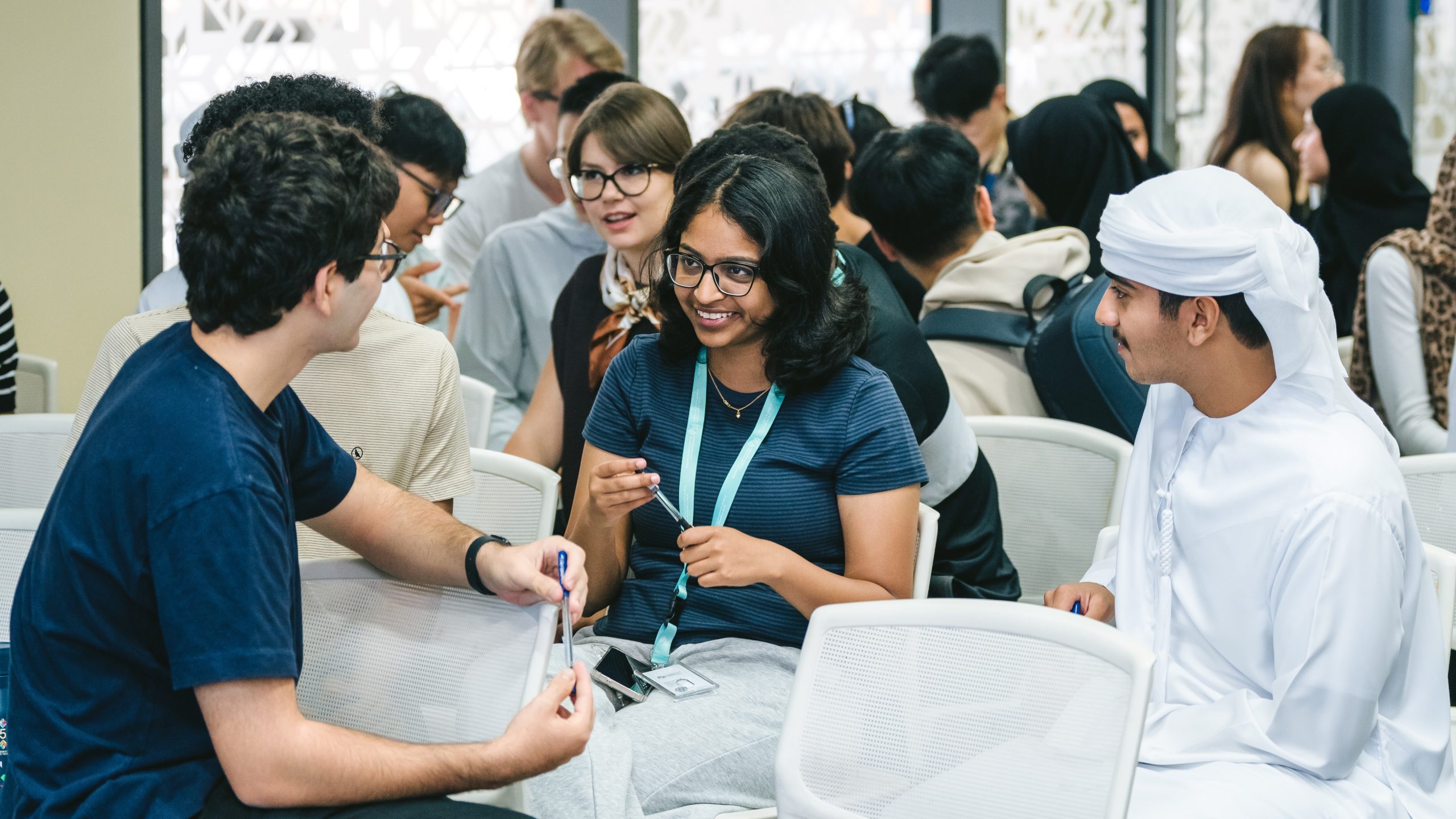
Being creative and instilling creativity in others, however, are two very different things. As the next generation of AI leaders and pioneers, creativity and innovative thinking are essential attributes for MBZUAI students to develop, and Churchill believes this must come through encouragement, exploration, and empathy.
“We have to foster environments in which research and teaching reward exploratory risk-taking, and focus on what ideas spark genuine innovation,” she says.
“I believe in encouraging our students to think about the intersection of human experience and AI as a malleable design space rather than a fixed boundary, and prompting them to synthesize technical rigor with empathetic inquiry.
“I also believe in cultivating collaborative, hands-on workspaces dedicated to iterative design, active experimentation, and open peer critique – where iterative failure and is celebrated, empowering students to review, rethink, and reconstruct.”
Stefanini agrees that creating environments where students are free to question assumptions, propose original ideas, and learn through hands-on exploration is key.
As an advisor and mentor, he also believes that understanding each student’s interests is important.
“Creativity is most effective when it is connected to areas that students care about,” he says. “From there, we explore together the needs and challenges within those domains, identifying real problems worth addressing.
“This naturally leads to structured brainstorming, where students work in teams with empathy, combining perspectives to explore ideas, gather information, and develop meaningful responses. In this way, creativity becomes both personally relevant and collaboratively enriched.”
Xia takes a slightly different approach, explaining that creativity “cannot be taught or instilled, but can be shown, illustrated, or hinted by metaphors”.
“It’s like the fragrance of a flower,” he says. “We cannot chase directly after it, but what we can do is prepare the water, soil and sunlight. In this way, the creative seed in each student will grow.”
Across MBZUAI, creativity is not treated as an abstract ideal, but as something to be developed, tested, and applied. In doing so, the University offers a practical proactive view of innovation in the AI age – one rooted not only in ideas, but in the work of making them real, useful, and impactful.
- incubation and entrepreneurship center ,
- creativity ,
- innovation ,
- mentorship ,
- faculty ,
- IEC ,
- campus ,
- Teaching ,
Related
MBZUAI opens the 2026-27 academic year with first cohorts in computational biology and human-computer interaction
- faculty ,
- students ,
- academic year ,
MBZUAI starts new academic year with distinguished global researchers
New appointments strengthen a faculty community that includes internationally recognized scientists, major prize-winners, and fellows of leading.....
Read More
A principled approach to cross-device federated learning
MBZUAI researchers have developed FedFit, a new framework for more efficient federated learning on resource-constrained devices.
- machine learning ,
- research ,
- student research ,
- conference ,
- icml ,