
Teaching soft robots the sense of touch
Tuesday, July 07, 2026
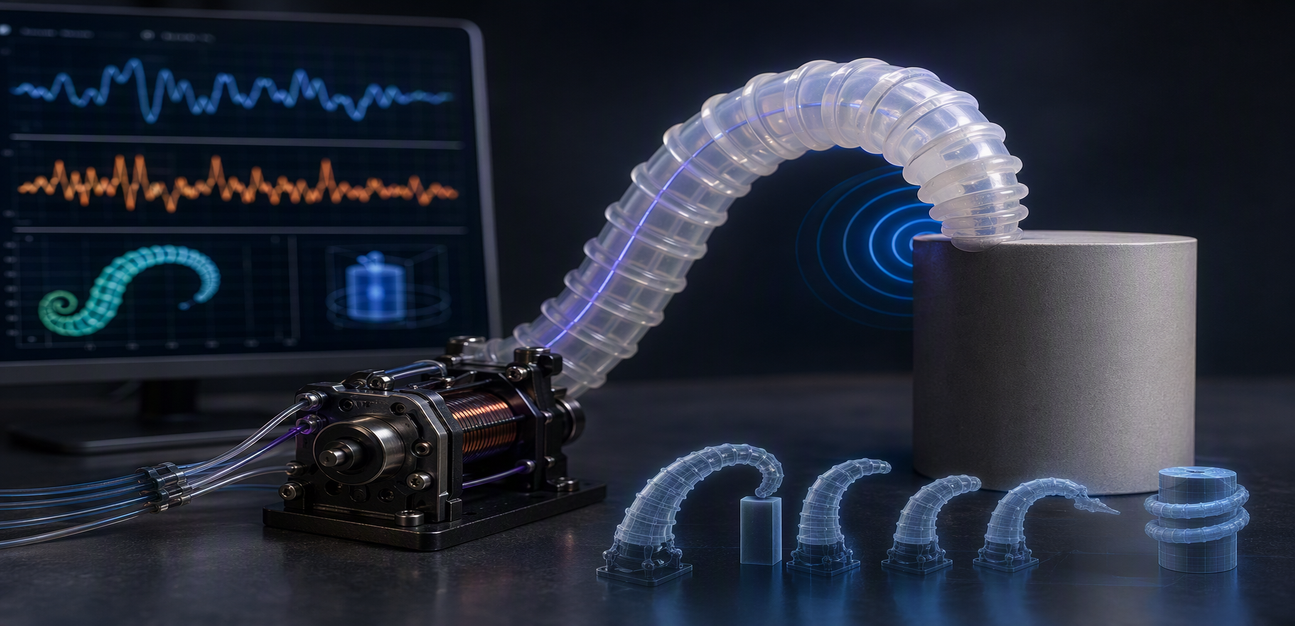
One challenge of developing robots that can interact with the environment is giving them the ability to gather information through the sense of touch. As humans, this comes naturally to us. We don’t think much — consciously, at least — about how much force it takes to pick up a coffee cup or to open a door. But robots don’t have this innate ability.
Researchers have developed ways that allow robots to sense through touch by placing tactile sensors on the robot exterior. But this method doesn’t work well in all cases. Take, for example, soft robots, which are designed to be pliant, flexible, lightweight, and safe when interacting with humans. External sensors can conflict with the main spirit of soft robotics because they add structural, mechanical, and electronic complexity, making soft robots heavier, less flexible, and potentially even less safe, says Ke Wu, visiting assistant professor of Robotics at MBZUAI.
Wu is the corresponding author of a recent study that proposes a new framework to help soft robots perceive objects in the environment without the help of tactile sensors. Instead of adding hardware to detect contact with objects, Wu and his co-authors’ framework interprets signals produced by the robot’s own motor. “We don’t need to add external tactile sensors along the robot body; we just need to see what’s going on with the current and the motor,” he says.
The study was published in IEEE Robotics and Automation Letters and presented at the IEEE International Conference on Robotics and Automation (ICRA) held in Vienna, Austria. Ibrahim Alsarraj, Yuhao Wang, Abdalla Swikir, Cesare Stefanini, Dezhen Song, and Zhanchi Wang are co-authors of the study.
How it works
The robot at the center of the research is a spiral continuum robot called SpiRob. Its movement is controlled by tendons that run through the center of its soft body; the tendons are connected to winches driven by DC motors. When voltage is applied to the motors, it drives current through the motor windings. This current generates torque, causing the rotor and winch to turn and pull on the tendons, which in turn drives the robot’s motion. When the robot touches an object, the external force changes the load on the motor-tendon system, and this change feeds back into the motor’s electrical response, including the magnitude and pattern of the current.
The researchers’ idea is to use this change in current to infer information about objects in the environment. In this way, Wu explains, the current isn’t only a control element but also provides a signal about if the robot is touching something. The challenge for the researchers was to build a model that could interpret fluctuations in current in a way that provides information about the object the robot interacts with.
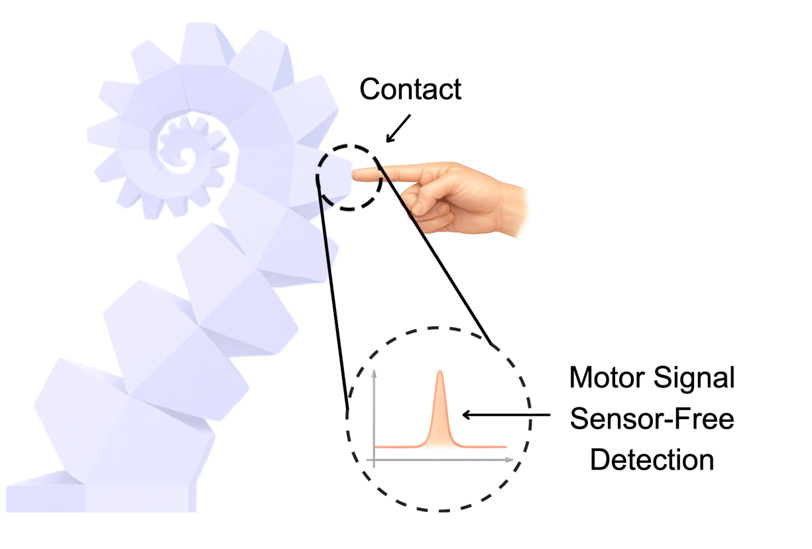
Researchers from MBZUAI and other institutions developed a new framework designed to help soft robots perceive objects in the environment without the help of tactile sensors. Instead of adding hardware to detect external contact, the approach interprets signals produced by the robot’s own motor to provide information about the objects it touches.
Standard modeling frameworks for tendon-driven continuum robots typically capture only the robot’s own dynamics, or movement. But the researchers’ approach integrates three elements: motor-electrical dynamics, which describe how voltage, current, torque, and motor motion are related; motor-winch dynamics, which describe how motor rotation is translated into tendon displacement and tension; and continuum-robot dynamics, which describe how the tendon-driven robot bends and moves along its body. By modeling all three together, the framework can determine what the motor-current profile should look like when the robot moves freely in space, while interpreting deviations from that baseline as evidence of external contact.
The researchers say that this is the first framework to model the three dynamics together for a continuum tendon-driven robot and it gives the robot three capabilities.
In passive perception mode, the motors produce a constant current while an object touches the robot somewhere along its body. Because the robot’s stiffness and mass vary along its length, decreasing from base to tip, contact at different locations produce different signatures in the current. This mode can identify contact between the robot and an object, and the location along the robot’s body where contact took place.
In active perception mode, the robot starts from a fully curled configuration and unfurls until its tip encounters an object. When the robots hit the object, the current spikes, triggering the robot to recoil. The researchers explain in their study that this capability was robust across different contact locations and baseline loads and transferred from a simulated environment to the physical robot.
The third capability, and perhaps most complex, is object size detection, where the researchers tested the system’s ability to estimate the size of a variety of cylinders by having the robot wrap around them. The researchers set up what they call a “lightweight, interpretable ensemble learning framework” and used data about the robot current and the displacement of the tendon to train the model. When the framework was deployed to the real robot, it was able to estimate cylinder diameters ranging from 10 to 70 millimeters with a margin of error of about 4 millimeters, an impressive result since the model was trained on only 35 examples.
AI and soft robots
Wu says that the field of soft robotics is at an important moment in its evolution. Artificial intelligence approaches are rapidly changing the discipline. Indeed, Wu and other researchers organized a workshop on the impact of AI on soft robotics held alongside ICRA.
MBZUAI Professor of Robotics Cesare Stefanini and MBZUAI Assistant Professor of Robotics Abdalla Swikir were co-organizers of the conference. Daniela Rus, professor at the Massachusetts Institute of Technology and member of the Board of Trustees of MBZUAI, gave a talk on the topic of Physical AI + Embodied AI for Soft Robots.
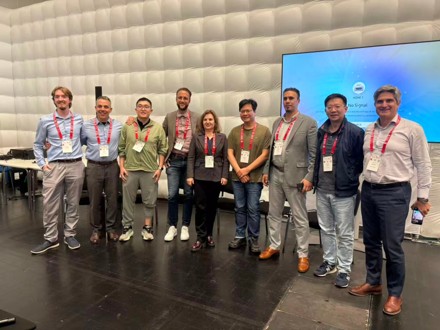 Ke Wu (third from left) co-organized a workshop on AI and soft robotics that took place alongside the recent ICRA conference in Vienna, Austria. Also pictured are Daniela Rus (center), and conference co-organizers Abdalla Swikir (third from right) and Cesare Stefanini (right).
Wu says that before the recent surge of interest in AI, much of soft robotics research focused on what are known as “low-level tasks,” such as tracking a trajectory, controlling the robot’s shape, or grasping an object. Even when soft robots were able to complete these tasks, Wu says, their movements were usually determined by a human operator or by a formal robotic control algorithm. While this work represents important progress, soft robots that can operate more independently in complex environments will require a different kind of capability: higher-level intelligence that allows them to make decisions, interpret situations, plan actions, and choose appropriate behaviors. Artificial intelligence might offer a way to provide that layer of intelligence.
With the help of AI, Wu says, soft robots hold the potential to become much more useful. World models — AI systems that learn how environments change and how actions affect those environments — are advancing rapidly and may help robots reason about complex and unpredictable surroundings. For soft robots, this could mean not only following a predefined motion, but also deciding how to interact with an object, when to adjust their behavior, and how to respond to unexpected contact or changes in the environment. AI may also help facilitate human-robot interaction, allowing a user to simply tell a robot what they want it to do, rather than programming specific movements or control rules.
Wu also thinks that there may be a convergence of rigid robots and soft robots in the future. Rigid robots have advantages in speed, precision, strength, and repeatability, while soft robots are especially useful for safe, compliant interaction with people, objects, and unstructured environments. Future robotic systems may combine the benefits of both approaches. For example, a robot could have a largely rigid structure for fast and accurate movement, while using a soft robotic arm or end effector to safely grasp delicate objects and interact with its surroundings.
Whatever the future holds, Wu says that it’s an exciting time to be working on these problems and witnessing how AI is rapidly changing what is possible in soft robotics.