
Commencement 2026: Why Ahmed Alshamsi sees field experts and youth as the real builders of the future
Thursday, May 14, 2026
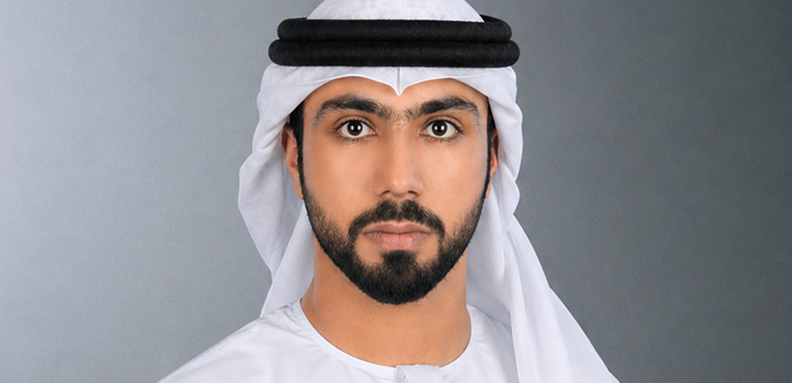
Ahmed Alshamsi isn’t focused on what artificial intelligence (AI) can replace. He’s focused on who it can enable.
As AI reshapes industries and societies, graduates such as Alshamsi represent a new kind of builder: one who sees the technology less as a destination and more as a tool that gains its real value when placed in the hands of people who understand real-world problems.
“AI will not replace those who adapt,” he says. “It amplifies their impact, in medicine, engineering, and environmental work.”
For him, the future of AI will not be defined by software developers alone. It will be shaped by doctors, engineers, educators, environmental specialists, policymakers, creatives, and young innovators who bring deep field knowledge.
A conversation on governance, society, and culture
Alshamsi recently took part in a session at the Hili Forum titled “Friend or Foe: AI and the Future of Governance, Societies and Culture,” alongside H.E. Khalid Alnuaimi, Director General of the Federal Youth Authority; H.E. Dr. Saeed Al Dhaheri, Director of the Center for Futures Studies at the University of Dubai; and Waheeda Al Hadhrami, Creative Industries Consultant. The session was moderated by ECSSR researcher Saqer Alnuaimi.
His contribution centered on a clear idea: that education, culture, and identity remain the building blocks of society, and AI should strengthen these foundations rather than weaken them.
He pointed to how different countries are already shaping AI around their own priorities. China, for example, has built its own search engines, local platforms, language models, and policy frameworks. For Alshamsi, this raises a question every society must answer: how do we ensure AI systems respect our own ethics, values, and community expectations?
In his view, AI should be a tool to strengthen education, family connections, and identity preservation, not weaken them.
Education and project-based learning
As he graduates with a Master of Science in Computer Vision from Mohamed bin Zayed University of Artificial Intelligence (MBZUAI), Alshamsi argues that education itself must evolve to spark creativity and welcome questions.
Pairing large language models (LLMs) and AI with project-based learning, he says, makes learning practical and engaging.
“Students should not just learn about AI,” he says. “They should use it to build, test, and create – turning the classroom into a place where ideas are tried out rather than only studied.”
Alshamsi credits MBZUAI with providing the foundation for both his technical and entrepreneurial growth.
“MBZUAI equipped me with advanced AI knowledge, research experience, and hands-on skills in building and deploying intelligent systems,” he says.
Beyond academics, the University’s collaborative environment and access to cutting-edge resources shaped his experience.
“The campus became my second home,” he says. “The people I met along the way, and the strong sense of community… I will miss that the most.”
Working alongside peers and faculty from around the world helped him refine his approach to problem-solving.
Digital trust in the age of deepfakes
He adds that while AI is an enabler, powerful technologies require responsible governance. He highlights deepfakes as one of the clearest challenges. As AI-generated content becomes more realistic, societies need reliable ways to verify what is authentic and what has been altered.
He points to C2PA, the Coalition for Content Provenance and Authenticity, as a standard worth adopting. It embeds verifiable information into media, showing who created a piece of content and what was edited, helping authenticate content and protect digital integrity.
For Alshamsi, the goal should be to see similar standards built into devices themselves, so authenticity is established at the source rather than added after the fact.
The larger point, he said, is simple: technical progress must be matched with governance, ethics, and accountability.
Enabling field experts to build
Beyond the Hili Forum, Alshamsi’s central belief is that the people closest to a problem are best positioned to solve it. A doctor understands healthcare challenges more deeply than someone outside the field. An environmental specialist understands pollution and public health risks. An engineer knows operational constraints from experience. An educator understands how students actually learn.
“What’s changed is what these experts can now do with that knowledge,” he says.
“Software development has never been easier. Prototyping, research, and data analysis have become more accessible, and ideas that once required large technical teams can now move from concept to working prototype in a fraction of the time.”
For Alshamsi, this doesn’t replace technical specialists. Instead, it creates a stronger model of collaboration, where field experts, young builders, and AI tools come together around real problems.
From university projects to real solutions
A central part of his message is about youth, and about how academic work can carry far greater value when connected to real-world needs.
He believes many promising ideas already exist inside universities, hackathons, and graduation projects. “It’s whether those ideas are matched with the right problem, the right field expert, and the right pathway beyond the classroom,” he says.
His own experience reflects this, beating more than 300 applicants to win first place at the GCC Cybersecurity Hackathon 2024. His team built on work that was originally part of a university project – showing that with the right framing and a real problem to solve, what begins as academic work can become something more.
For Alshamsi, this points to a practical opportunity for universities, government entities, and companies to share real industry challenges as thesis topics, graduation projects, or prototype briefs. This would allow students to choose problems that match their interests, and give industries access to fresh thinking and early-stage solutions, he suggests.
This is also the spirit behind his startup. Y71 takes its name from youth, and its original mission was to empower young national talents to create solutions to real-world problems – not within one narrow sector, but across whatever fields matter.
“Youth should be trusted to build,” he says, “with field experts in the loop.”
Recognition and the UAE ecosystem
Throughout his journey, Alshamsi has received meaningful moments of recognition that he sees as part of the UAE’s broader commitment to supporting youth and innovation.
He was honored to receive an award for impact in AI from His Highness Sheikh Nahyan bin Mubarak Al Nahyan and expresses his thanks to Sandooq Al Watan and the organizers who created the platform.
During GITEX, he was recognized by His Highness Sheikh Hamdan bin Mohammed Al Maktoum, and was also honored to meet His Highness Sheikh Hazza bin Zayed Al Nahyan – a moment that reinforced his commitment to keep building.
What comes next
While many graduates leave with research alone, Alshamsi enters the next phase of his career with his startup already in motion. And looking forward, he is focused on scaling his impact.
The greatest value, he reiterates, comes when young builders are empowered with AI tools while field experts stay closely involved to guide solutions with real-world knowledge.
“National entities create the environment,” he says. “Universities develop the talent. Field experts define the problems. Youth bring the energy and curiosity.”
- computer vision ,
- entrepreneur ,
- startup ,
- youth ,
- M.Sc. ,
- cybersecurity ,
- commencement ,
- master's ,
- Commencement 2026 ,
Related

Building AI that understands the Gulf’s climate challenges
An MBZUAI team has developed Gulf Climate Agent (GCA), an AI framework designed specifically for climate decision.....
- ACL ,
- conference ,
- computer vision ,
- climate change ,
- research ,

Training multimodal AI with limited labels for a world it has never seen
A new framework from MBZUAI researchers helps AI systems remain effective when data is scarce and inputs.....
Read More
Two heads are faster than one
MBZUAI researchers have developed a new approach to video understanding that reduces computational costs while maintaining accuracy.
- research ,
- large multimodal model ,
- CVPR ,
- video ,
- conference ,