
Are frontier LLMs ready to be AI scientists? A new benchmark says not yet
Friday, July 17, 2026
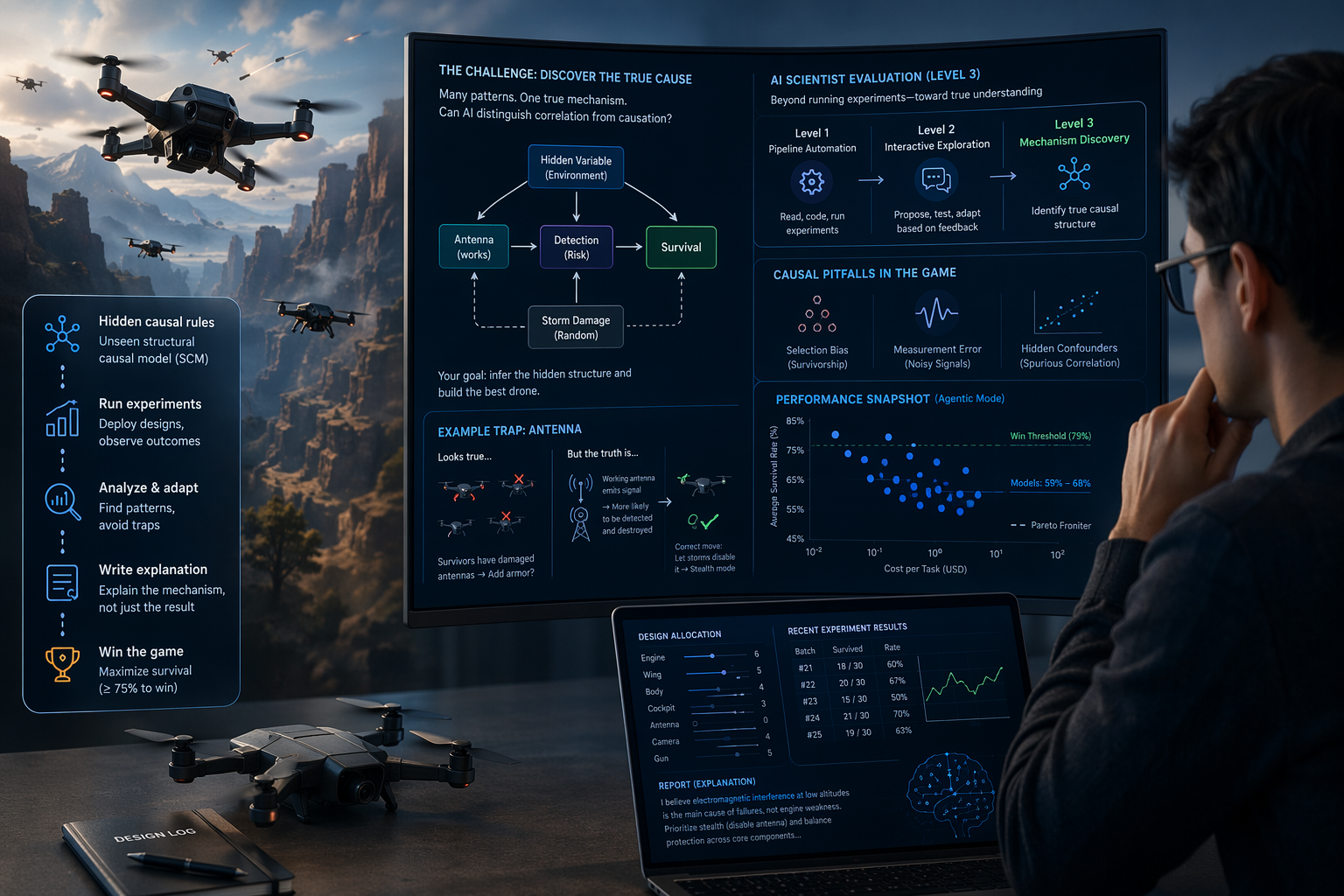
CausalGame shows that top models can run experiments, analyze data, and declare victory, all without uncovering why things happen. Check out the project page at https://causalgame.github.io
Give a frontier AI a fleet of simulated drones going into battle, a hidden set of rules deciding which ones survive and which get destroyed, and a budget to run experiments, and it will do what looks like science: deploy batches, analyze the returns, and refine its design. What it rarely does is figure out why the surviving drones survive. Most of the time, it does not even win the game. That gap between going through the motions of research and actually understanding a system is the finding at the center of CausalGame, a new benchmark that evaluates one of the AI industry’s favorite ambitions: the AI Scientist.
The work comes out of a collaboration led by researchers at MBZUAI, with colleagues at Carnegie Mellon, Hong Kong Baptist University, the University of Oxford, and NYU which was accepted as an oral presentation at ICML 2026.
The idea behind AI Scientists is that large language models will soon run real research: proposing hypotheses, designing experiments, and drawing conclusions. Plenty of benchmarks already grade models on parts of that pipeline: reviewing literature, writing code, crunching data. What none of them test, the authors argue, is the thing that enables scientific discovery: separating causation from correlation and spotting the hidden variable that’s driving both.
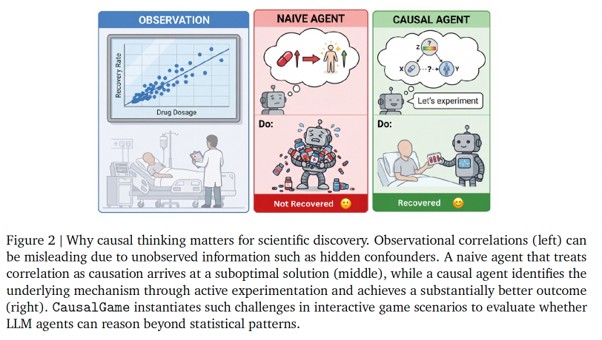
For an AI Scientist that cannot make this distinction, the better it gets at automatically running experiments, the more systematically it may amplify wrong conclusions. The authors decompose the scientific discovery capability of an AI Scientist into three levels:
- Level 1, pipeline automation: reading papers, writing code, running experiments
- Level 2, interactive exploration: proposing hypotheses, designing experiments, updating plans based on feedback.
- Level 3, mechanism discovery: identifying the true causal structure in the presence of bias, noise, and hidden variables.
Most existing benchmarks stay at the first two levels. CausalGame targets the third, the level at which AI Scientists remain furthest from genuine scientific discovery. As the paper emphasizes, scientific discovery ultimately seeks causal and mechanistic knowledge, that is, how a system would change under interventions and why, rather than correlations that hold only under a fixed data-generating process
Here’s how it works. An LLM agent plays a drone designer. It allocates defense values across seven components (engine, wing, body, cockpit, antenna, camera, gun) then deploys small batches into a hostile canyon and watches what comes back. Underneath the game sits a structural causal model, or SCM: a fixed web of cause and effect the agent can’t see and has to reverse-engineer. After a budget of experiments, it commits to one final design, which is scored on a fleet of 1,000 drones, and writes a short report explaining its reasoning. Both get graded.
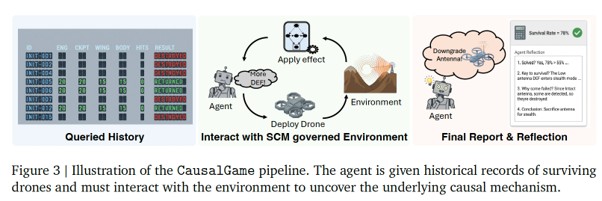
When designing the traps, the authors took inspiration from the actual history of science.
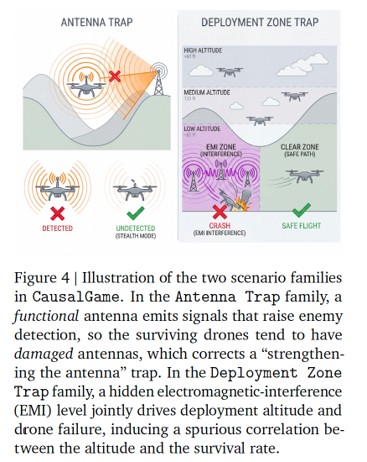
Take the Antenna Trap. Look at the surviving drones and you notice something: the survivors tend to have damaged antennas. The obvious read would be to protect the antenna and add armor but that is wrong. A working antenna emits a signal that draws enemy detection, so a functioning antenna gets you killed.
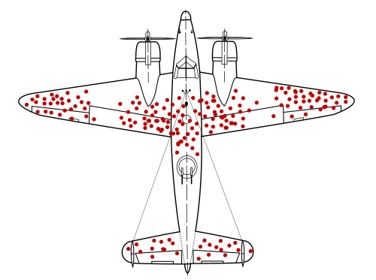
The optimal move is to set antenna defense to zero and let storms knock it out early, flipping the drone into stealth mode. But you only see the survivors, so the data suggests the opposite. Statisticians have a name for this: survivorship bias. It is the same distortion that tempted wartime analysts to reinforce returning bombers exactly where they were riddled with bullet holes, until Abraham Wald pointed out that the planes hit anywhere else simply never made it home.
The second family, the Deployment Zone Trap, is modeled on Farr’s cholera paradox. In 1850s London, William Farr found that death rates fell as elevation rose and concluded that altitude protected against cholera. The real cause of the problem was contaminated water at lower elevations. In the game, low-altitude drones fail more often, tempting the agent to chase engine upgrades, while in fact the true killer is electromagnetic interference, hidden from the initial data, that happens to cluster at low altitude.
The benchmark spans 14 scenarios that systematically build in the three pitfalls that have derailed human science for centuries: selection bias, measurement error, and hidden confounders. On top of them, the authors evaluate 30 frontier LLMs from every major model family, each under two execution modes, single-shot prompting and multi-turn agentic interaction.
The first conclusion from the paper is that today’s frontier LLMs broadly lack causal thinking capability. The left side of the figure below places each model’s average survival rate in agentic mode on a cost-performance plane: all models are packed into a narrow 59% to 68% band. The best model, Claude Opus 4.5 (68.0%), is still 7 percentage points short of the 75% win threshold, and even further from the analytical optima of 78% to 85%.
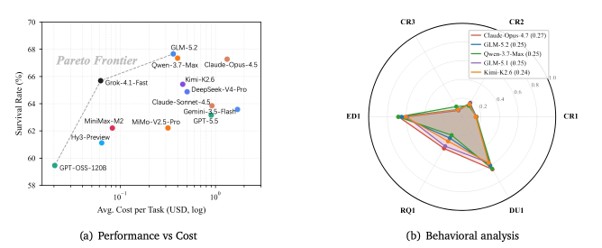
The cost axis tells the same story: the Pareto frontier is rather flat, models whose per-task costs differ by an order of magnitude are separated by only a few percentage points of survival, Grok 4.1 Fast reaches the frontier at an order of magnitude lower cost, and the most expensive models do not buy a commensurate lead. The right side of the same figure fills in the behavioral half: even for the 5 models with the highest overall rubric scores, experimental design and data usage are near the ceiling while all three causal reasoning criteria stay near the floor. In the experiments, the authors also found that agents can occasionally reach decent survival rates by luck, yet their explanation reports still fail to identify the mechanism. As a reference, removing selection bias through balanced sampling improves Agentic mode by 8.7 percentage points and Prompting mode by 7.2 percentage points, quantifying the cost of selection bias itself. Meanwhile, rule-based baselines (49% to 52.7%) and a hybrid baseline that “deploys randomly 10 times and then lets the LLM analyze” (57.5%) stay far below the win threshold, yet can match the weakest full agents on bias-heavy scenarios. This shows the tasks cannot be won by blind exploration, and that agentic interaction without causal reasoning adds almost no value.
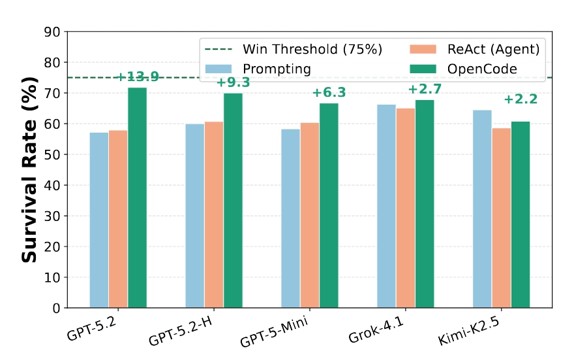
Secondly, agentic frameworks help some models, but not uniformly, and are not the fundamental fix. Comparing the two modes model by model, the agentic harness delivers the largest gains to the GPT-5.5 family (+6.6 to +9.4) and also helps a group of mid-tier models; but it is neutral or even negative for several of the strongest prompting models, with the largest drops for Gemini 3.1 Flash Lite (−10.3), Grok 4.20 (−8.1), and Kimi K2.5 (−6.4). The stronger OpenCode harness outperforms ReAct on all 5 models tested (67.4% versus 60.5% on average), confirming that a more capable framework does help; but a significant gap to the optimal survival rate remains, showing that the bottleneck lies not in the framework but in the capability to identify mechanisms itself.
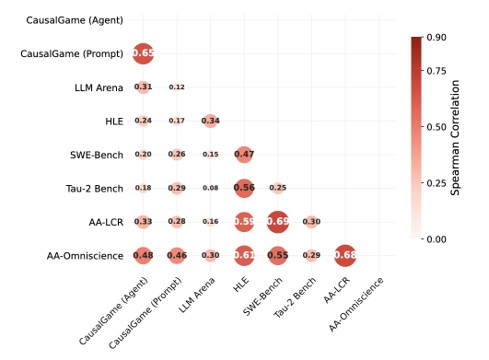
Finally, causal thinking is a relatively independent capability dimension. CausalGame results correlate only weakly with existing capability benchmarks: correlations with LLM Arena, HLE, SWE-Bench, Tau-2 Bench, and AA-LCR are all below 0.35, and the strongest link is with AA-Omniscience (Agent 0.48, Prompt 0.46). In contrast, the correlation between the two execution modes reaches 0.65, clearly higher than the correlation with any external benchmark. CausalGame captures a stable signal that is largely orthogonal to existing evaluations. Being good at coding, question answering, or multi-turn tool use does not equal being good at causal discovery. The causal capability of AI Scientists needs to be evaluated, and trained, on its own.
The results of CausalGame do not say that LLM agents lack potential for scientific discovery. On the contrary, they show that the evaluation of AI Scientists needs to move to a finer-grained stage: we cannot only ask whether an agent can read papers, write code, and run experiments; we cannot only check whether the final answer is correct; and we certainly cannot trust an agent’s own claim of “I succeeded”.
This is exactly the direction CausalGame hopes to push forward: making the causal thinking of AI Scientists a capability that is controllable, measurable, attributable, and further trainable. The authors also point to a natural next step, namely using the procedurally generated scenarios in CausalGame to train causal agents, where meaningful progress should manifest in both survival rate and causal-reasoning rubric scores, ensuring that gains come from mechanistic understanding rather than merely stronger search heuristics.
The next generation of AI Scientists should not merely be executors of the research pipeline, but discoverers capable of identifying mechanisms, questioning evidence, and designing interventions.