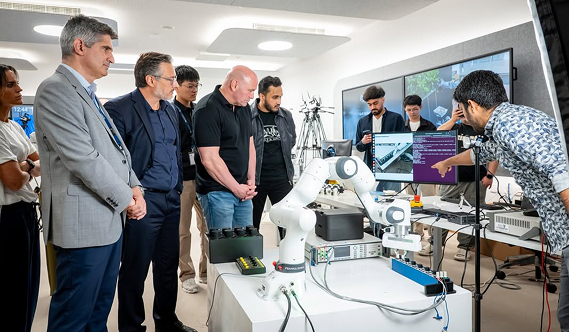
delegation
student achievements
machine learning
ranking
university
faculty achievements
baldwin
nakov
zhang
song
partnerships
hackathon
executive program
student life
random
ML department
el saddik
natural language processing
research talk
research
healthcare
genetics
computer science
xing
president
president office
innovation
chairman
provost
academic programs
karray
yaqub
sustainability
energy
transport
industry
training
outreach
student events
applications
jordan
laureate faculty program
guizani
internet of things
telecom
federated learning
consulting
climate change
ethical AI
AI policymaking
AI talks
computer vision
pandemic
brady
robotics
professional services
university. first cohort
shao
webinar
smart cities
appointment
first cohort
licensing
advisory board
entrepreneurship
digital twins
metaverse
li
xia
ML research
salman khan
image analysis
ho
open source
operating system
fake news
graduation
women in AI
biomedical
kai-fu lee
black box
gu
xu
nandakumar
security
drones
deep learning
cancer
student research
takac
reinforcement learning
supervised learning
STEM
statistics
mathematics
autonomous vehicles
speech recognition
rankings
debbah
exascale computing
high performance computing
causal discovery
entreprenuership
aaraj
cryptography
xie
CIAI
AI operating systems
agriculture
projects
horvath
privacy
biometrics
jain
dai
weizmann
rus
kun
training programs
delegations
training program
MoUs
GITEX
iraq
faculty
collaborations
le song
Ai for leadership
جيزاني
إنترنت الأشياء
اتصالات
conferences
nlp
admissions
students
careers
AI
tech
conference
neurips
AI Quorum
commencement 2022
hao li
medicine
COP28
fellow
achievements
data science
Research talks
object detection
online
alumni
Drug design
climate
Health care
yuanzhi li
class of 2022
entrepreneur
startup
education
kochmar
intelligent tutoring systems
human generation models
xiaodan liang
internships
employers
الصناعة
autodub
voice synthesizer
generative AI
causality
fahad khan
machine visual intelligence
patient care
chatbot
vicuna
large language models
patient predictions
guilloux
health
artificial intelligence
board
ICLR2023
language models
youth
aji
phenotype
partnership
الأمن
الشباب
wind
graduate students
renewables
commencement 2023
hacking
RIKEN-AIP
professor xing
noisy labels
icml
liu
social sustainability
البحوث
ليو
تسميات صاخبة
llm
chatGPT
Anil Jain
biometric recognition
engineering
student highlights
valedictorian
social media
memes
propaganda
aviation
Dimensionality
dataset
بيانات
الأبعاد
ACL2023
class of 2023
environmental science
ugrip
IEEE MetaCom
orientation
cancer diagnostics
gender bias
LLM
llms
language model
jais
ICCV
decarbonization
video
EMNLP
dignitaries
ai armchair
incubator
startups
research center
foundation models
incubation
foundational models
large language model
malaria
finance
partners
IBM
Arabic language
MICCAI
endowment
GenAI
end of the year
LLM360
Accomplishments
diversity
energy efficiency
Emulating brain
معالجة اللغة الطبيعية
اللغة العربية
computational biology
smart health
food security
startup business
MIEC
IEC
OpenAI
United Nations
World Governments Summit
الابتكار
AAAI
vision-language models
Human–computer interaction
post-graduate
opportunities
graduates
Masdar
Arabic LLM
alumni relations
recruitment
CASE
Women’s Day
Emirates
researchers
International Women’s Day
MEP
fifth cohort
EACL
Microsoft
Ethics & AI
BiMediX
PALO
GLaMM
GeoChat
MobiLLaMA
SLMs
media
disinformation
university’s provost
Timothy Baldwin
Eric Xing
Iryna Gurevych
Computer Vision Department
Machine Learning Department
BioMap
Quris-AI
Remote patient
Predictive healthcare
Maxim Panov
ML
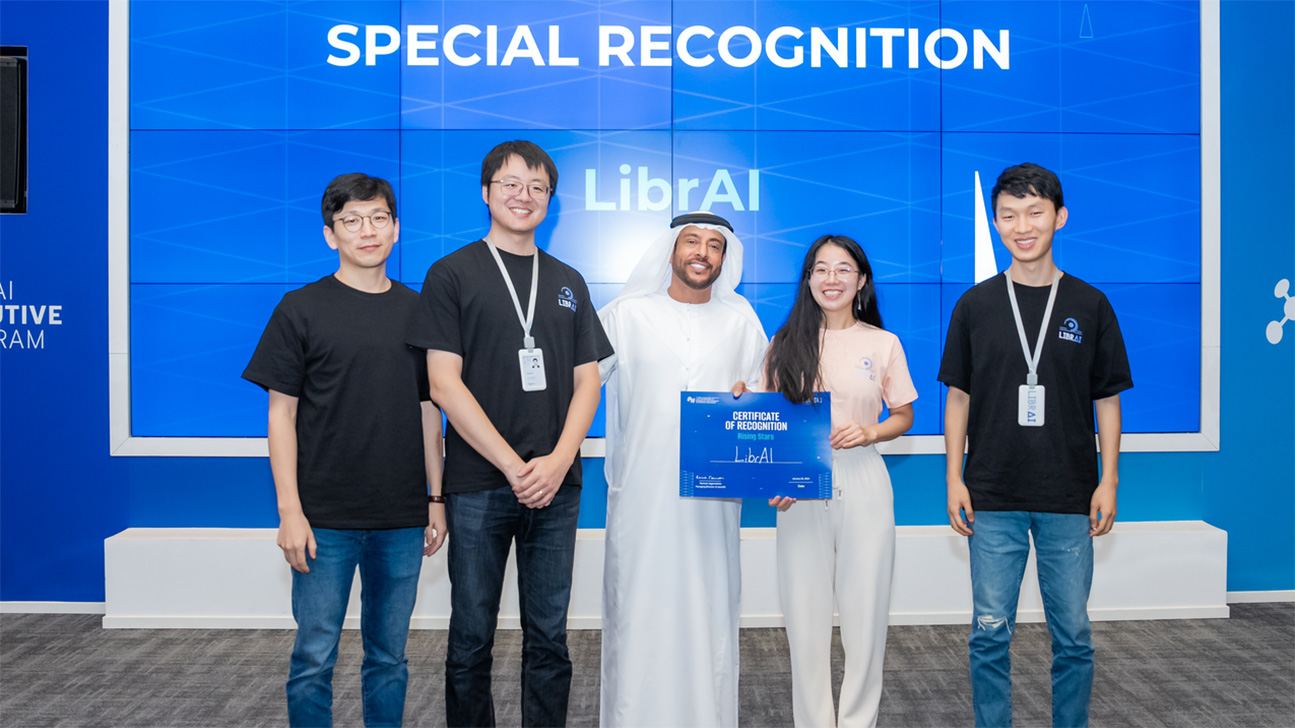
LibrAI
LERAI Foundation
International Olympiad
Dr. Yova Kementchedjhieva
embodied AI
ICLR2024
flood assessment
AI models
OpenStreetMap
volunteers
EAD
DMT
Aldar
Emaar
UAE flood assessment committee
algorithm
Memorandum
ICLR
commencement 2024
Etihad Airways
Silal
text to image
Petuum
K2-65B
class of 2024
Ph.D.
M.Sc.
MBZUAI
CV
metaverse center
avatar
CVPR
world
AI research
innovators
ADRO
DCT
مركز حضانة وريادة الأعمال
الروبوتات
NAACL
Alumina
Alumina Spotlight
Alumni Spotlight
summer school
Olympic Games 2024
intensive artificial intelligence program
MEP-A
GITEX Global
campus
accommodation
amenities
wellbeing
acl 2024
Chinese LLM
icml 2024
LMM
Dezhen Song
VLM
hallucination
acl2024
مجموعات البيانات
leadership
women’s empowermen
Emirati Women’s Day
US election
capstone projects
community
HCI
human-centered design
human motion
efficiency
systems
algorithms
biology
genomes
data
Gitex 2024
IROS 2024
Intelligent Robots and Systems
Intelligent Robots
Professor Sami Haddadin
telemedicine
award
accessibility
AI4SD
medical
multilingual
visual analytics GPT
جايتكس
جايتكس 2024
لغات متعددة
النماذج الكبيرة متعددة الوسائط
النموذج المؤتمت للتحليل البصري للبيانات
الطب
sami haddadin
robot learning
natural language processing conference
natural language
علم الأحياء
البيانات
الجينومات
الرعاية الصحية التنبئية
segmentation
research assistant
op-ed
academic centers
research and development
Google
language
empathy
emotions
bias
culture
cited
fact checking
hardware
benchmarking
cultural awareness
ICDM
Abu Dhabi
IROS
COLING
inclusion
summit
impact
problem-solving
prompting
processing
multimodal
code
instruction tuning
atlas
You AI Podcast
بودكاست الذكاء الاصطناعي
AI Talks
حوارات الذكاء الاصطناعي
casual discovery
variables
determinism
student
prediction
applied AI
logistics
literature
science fiction
books
fiction
Asimov
ethics
future
neural networks
optimization
second-order
المعيارية
الوعي الثقافي
tokens
ACCV
languages
benchmark
linguistics
inclusivity
cybersecurity
COLING 2025
organizing committee
Safety
ethical
responsible
Audiomatic
Limb
Cradle AI
Nutrigenics Care
growth
strategy
environment
food
forecasting
memory
Tim Baldwin
predictions
agentic
educational affairs
organizations
talent
undergraduates
undergraduate program
academia
mentor
mentorship
robots
tree of robots
nature
paper
classification
machines
reasoning
intelligence
workshop
berkeley
Augmented Humans
AHs
ACM
augmentation
World Health Day
diagnostics
personalized medicine
illness
diseases
visual language model
public health
engagement
casual relationships
music
cohort6
AIRoC
AD-AIRoC
disentangled representation
Newton
Mendel
evaluation framework
genomics
data carpentry
carpentries
institute of digital public health
human-centered AI
AI for good
Stanford
design
crowdsourcing
misinformation
moderation
dialogue
low resource
UNESCO
PAN
launch
IFM
silicon valley
ai lab
commencement 2025
commencement
Class of 2025
speech
address
Institute of Foundation Models
Nanda
Sherkala
Atlas-Chat
writing
interactive
assistant
single cell omics
bioinformatics
oceans
world ocean day
water
marine
conservation
SSMs
art
panel
identity
expression
digital
physical
communication
Vision language model
geospatial
remote sensing
MLLMs
edge devices
GPT
diagnosis
prognosis
image generator
diffusion models
causal relationships
الوسائط المتعددة
stories
التشخيص
التخرج
التشخيص الاستباقي
الطالب المتفوق
المتحدث باسم الدفعة
أخبار الخريجين
دفعة عام 2025
الصحة
الرعاية الصحية
تعلّم الآلة
إنجازات الطلبة
حفل التخرج
المتحدثة باسم الدفعة
Students' Achievements
News
Heath Care
Graduation Ceremony
2025 Cohort
Neurodegenerative
ai framework
machine intelligence
tactile skills
geopixel
HPP
human phenotype project
digital twin
botany
plants
watermarking
watermark
ACL
weather
vision transformer
conversation
faith
spirituality
religion
connection
discussion
مختبر الذكاء الاصطناعي
معهد النماذج التأسيسية
وادي السيليكون
إطلاق
creativity
reversal curse
performance
transformer
best paper
medical imaging
jailbreaking
AGLN
Arabic
Academy
dependence
analysis
Deepfakes
deep fake
code switching
Undergraduate
business
master's
phd
master’s
محولات الرؤية
الطقس
جودة الهواء
Meta
internship
images
videos
Bachelor's
intake
Bachelor’s
IOAI
International Olympiad in AI
competition
host
K2 Think
Teaching
CTL
AIM for Scale
journal
autonomous laboratories
Mailis
workplace
information
agents
simulation
presentation
imaging
medical images
RAG
honorary degree
conferral
degree
doctorate
board of trustees
Sam Altman
event
ceremony
Honorary Doctorate
analytics
service
MoU
MIT
society
efficient computing
Entrepeneurship
build
Economy
economics
guest lecture
guest talk
Nobel Prize
governance
digital policy
talk
founder
hospital
diabetes
cardiovascular
vision
robot dog
wearable
assistive
showcase
demo
UAE
resilience
disaster management
precision medicine
incubation and entrepreneurship center
builders
العروض التجريبية
profile
diffusion model
cells
gene expression
venture capital
funding
drone
transmedia
aerial
aquatic
bio-inspired
demonstration
tokenization
motion
fellowships
multimodal large language models
ADIPEC
infrastructure
case study
autonomous
solar
cooling
neuroscience
brain-computer interface
The Academy
Global AI Leadership Program
GAILP
genbio
MAAI
professional
educational program
AI learning
AI education
NextGen
voice
detectors
coding
biorobotics
AI Innovation Day
on campus
world model
Senior Citizens
Awareness
adversarial learning
audio
BMVC
waste
fine-tuning
Royal Society
uncertainty
reliable
biodiversity
collaboration
queries
captcha
Computational Biology Program
avian
birds
detection
fake
causal representation learning
oncology
causal reasoning
Scholarship
Tahnoon bin Zayed Scholarship in AI Excellence
spatial reasoning
3D
K2
delivery
IAAI
Institute for Agriculture and Artificial Intelligence
UAE Presidential Court
Gates Foundation
farmers
farming
advisory
support
ecosystem
AI4GS
global south
equitable
representation
Amazon Web Services
largelanguagemodel
k2-v2
التنوع البيولوجي
الموثوقية
عدم اليقينية
cinema
digital public health
social impact
launch lab
symposium
World Economic Forum
WEF
social
economic
humanity
Davos
foundation model
reasoning IFM
sovereign
humanoid robotics
five year anniversary
celebration
anniversary
coins
commemorative
fellowship
executive
program
غوغل
Report
supercomputer
postdoc
Emirati
byzantine
government
GARA
loneliness
social good
statistics and data science
suhoor
ramadan
alumni advisory board
image
research scientist
Computational linguistics
human judgment
labels
Hindi
برنامج الريادة العالمية في الذكاء الاصطناعي للقادة
grant
researcher
low-resource languages
DeepMind
emotion
differential privacy
مشاعر الإنسان
فهم
علم النفس
الآلات
القاموس المفتوح
Commencement 2026
graduate
large multimodal model
papers
embodied intelligence
datasets
IEEE
AISTATS
framework
Class of 2026
talent development
arts fellowship
debate
Agentic AI
MBRGS
UNICON
executive education
Dean
computing
biological and life sciences
watermarks
EGP
Nature Genetics
ICRA
soft robotics
control
multimodal model
OSPA
vice provost
تعزيز القدرات
مؤتمر الإنسان المعزز
AI-powered soft robots
sense touch
tactile sensors
motor current
detect contact
object size
FinChain
المسائل المالية
خطوات الاستدلال
financial reasoning benchmark
LLM evaluation
ArabCulture-Dialogue
Arab cultural context
Emirati dialect
Cultural AI
Multimodal AI
ReProbe
LLM reasoning
AI verification
AI Agents
Scaling
SSM
WaveSSM
Transformers
collaborative reasoning
3D foundation model
طائرة مسيرة
medical AI
academic year
You AI Podcast
delegation
student achievements
machine learning
ranking
university
faculty achievements
baldwin
nakov
zhang
song
partnerships
hackathon
executive program
student life
random
ML department
el saddik
natural language processing
research talk
research
healthcare
genetics
computer science
xing
president
president office
innovation
chairman
provost
academic programs
karray
yaqub
sustainability
energy
transport
industry
training
outreach
student events
applications
jordan
laureate faculty program
guizani
internet of things
telecom
federated learning
consulting
climate change
ethical AI
AI policymaking
AI talks
computer vision
pandemic
brady
robotics
professional services
university. first cohort
shao
webinar
smart cities
appointment
first cohort
licensing
advisory board
entrepreneurship
digital twins
metaverse
li
xia
ML research
salman khan
image analysis
ho
open source
operating system
fake news
graduation
women in AI
biomedical
kai-fu lee
black box
gu
xu
nandakumar
security
drones
deep learning
cancer
student research
takac
reinforcement learning
supervised learning
STEM
statistics
mathematics
autonomous vehicles
speech recognition
rankings
debbah
exascale computing
high performance computing
causal discovery
entreprenuership
aaraj
cryptography
xie
CIAI
AI operating systems
agriculture
projects
horvath
privacy
biometrics
jain
dai
weizmann
rus
kun
training programs
delegations
training program
MoUs
GITEX
iraq
faculty
collaborations
le song
Ai for leadership
جيزاني
إنترنت الأشياء
اتصالات
conferences
nlp
admissions
students
careers
AI
tech
conference
neurips
AI Quorum
commencement 2022
hao li
medicine
COP28
fellow
achievements
data science
Research talks
object detection
online
alumni
Drug design
climate
Health care
yuanzhi li
class of 2022
entrepreneur
startup
education
kochmar
intelligent tutoring systems
human generation models
xiaodan liang
internships
employers
الصناعة
autodub
voice synthesizer
generative AI
causality
fahad khan
machine visual intelligence
patient care
chatbot
vicuna
large language models
patient predictions
guilloux
health
artificial intelligence
board
ICLR2023
language models
youth
aji
phenotype
partnership
الأمن
الشباب
wind
graduate students
renewables
commencement 2023
hacking
RIKEN-AIP
professor xing
noisy labels
icml
liu
social sustainability
البحوث
ليو
تسميات صاخبة
llm
chatGPT
Anil Jain
biometric recognition
engineering
student highlights
valedictorian
social media
memes
propaganda
aviation
Dimensionality
dataset
بيانات
الأبعاد
ACL2023
class of 2023
environmental science
ugrip
IEEE MetaCom
orientation
cancer diagnostics
gender bias
LLM
llms
language model
jais
ICCV
decarbonization
video
EMNLP
dignitaries
ai armchair
incubator
startups
research center
foundation models
incubation
foundational models
large language model
malaria
finance
partners
IBM
Arabic language
MICCAI
endowment
GenAI
end of the year
LLM360
Accomplishments
diversity
energy efficiency
Emulating brain
معالجة اللغة الطبيعية
اللغة العربية
computational biology
smart health
food security
startup business
MIEC
IEC
OpenAI
United Nations
World Governments Summit
الابتكار
AAAI
vision-language models
Human–computer interaction
post-graduate
opportunities
graduates
Masdar
Arabic LLM
alumni relations
recruitment
CASE
Women’s Day
Emirates
researchers
International Women’s Day
MEP
fifth cohort
EACL
Microsoft
Ethics & AI
BiMediX
PALO
GLaMM
GeoChat
MobiLLaMA
SLMs
media
disinformation
university’s provost
Timothy Baldwin
Eric Xing
Iryna Gurevych
Computer Vision Department
Machine Learning Department
BioMap
Quris-AI
Remote patient
Predictive healthcare
Maxim Panov
ML
LibrAI
LERAI Foundation
International Olympiad
Dr. Yova Kementchedjhieva
embodied AI
ICLR2024
flood assessment
AI models
OpenStreetMap
volunteers
EAD
DMT
Aldar
Emaar
UAE flood assessment committee
algorithm
Memorandum
ICLR
commencement 2024
Etihad Airways
Silal
text to image
Petuum
K2-65B
class of 2024
Ph.D.
M.Sc.
MBZUAI
CV
metaverse center
avatar
CVPR
world
AI research
innovators
ADRO
DCT
مركز حضانة وريادة الأعمال
الروبوتات
NAACL
Alumina
Alumina Spotlight
Alumni Spotlight
summer school
Olympic Games 2024
intensive artificial intelligence program
MEP-A
GITEX Global
campus
accommodation
amenities
wellbeing
acl 2024
Chinese LLM
icml 2024
LMM
Dezhen Song
VLM
hallucination
acl2024
مجموعات البيانات
leadership
women’s empowermen
Emirati Women’s Day
US election
capstone projects
community
HCI
human-centered design
human motion
efficiency
systems
algorithms
biology
genomes
data
Gitex 2024
IROS 2024
Intelligent Robots and Systems
Intelligent Robots
Professor Sami Haddadin
telemedicine
award
accessibility
AI4SD
medical
multilingual
visual analytics GPT
جايتكس
جايتكس 2024
لغات متعددة
النماذج الكبيرة متعددة الوسائط
النموذج المؤتمت للتحليل البصري للبيانات
الطب
sami haddadin
robot learning
natural language processing conference
natural language
علم الأحياء
البيانات
الجينومات
الرعاية الصحية التنبئية
segmentation
research assistant
op-ed
academic centers
research and development
Google
language
empathy
emotions
bias
culture
cited
fact checking
hardware
benchmarking
cultural awareness
ICDM
Abu Dhabi
IROS
COLING
inclusion
summit
impact
problem-solving
prompting
processing
multimodal
code
instruction tuning
atlas
You AI Podcast
بودكاست الذكاء الاصطناعي
AI Talks
حوارات الذكاء الاصطناعي
casual discovery
variables
determinism
student
prediction
applied AI
logistics
literature
science fiction
books
fiction
Asimov
ethics
future
neural networks
optimization
second-order
المعيارية
الوعي الثقافي
tokens
ACCV
languages
benchmark
linguistics
inclusivity
cybersecurity
COLING 2025
organizing committee
Safety
ethical
responsible
Audiomatic
Limb
Cradle AI
Nutrigenics Care
growth
strategy
environment
food
forecasting
memory
Tim Baldwin
predictions
agentic
educational affairs
organizations
talent
undergraduates
undergraduate program
academia
mentor
mentorship
robots
tree of robots
nature
paper
classification
machines
reasoning
intelligence
workshop
berkeley
Augmented Humans
AHs
ACM
augmentation
World Health Day
diagnostics
personalized medicine
illness
diseases
visual language model
public health
engagement
casual relationships
music
cohort6
AIRoC
AD-AIRoC
disentangled representation
Newton
Mendel
evaluation framework
genomics
data carpentry
carpentries
institute of digital public health
human-centered AI
AI for good
Stanford
design
crowdsourcing
misinformation
moderation
dialogue
low resource
UNESCO
PAN
launch
IFM
silicon valley
ai lab
commencement 2025
commencement
Class of 2025
speech
address
Institute of Foundation Models
Nanda
Sherkala
Atlas-Chat
writing
interactive
assistant
single cell omics
bioinformatics
oceans
world ocean day
water
marine
conservation
SSMs
art
panel
identity
expression
digital
physical
communication
Vision language model
geospatial
remote sensing
MLLMs
edge devices
GPT
diagnosis
prognosis
image generator
diffusion models
causal relationships
الوسائط المتعددة
stories
التشخيص
التخرج
التشخيص الاستباقي
الطالب المتفوق
المتحدث باسم الدفعة
أخبار الخريجين
دفعة عام 2025
الصحة
الرعاية الصحية
تعلّم الآلة
إنجازات الطلبة
حفل التخرج
المتحدثة باسم الدفعة
Students' Achievements
News
Heath Care
Graduation Ceremony
2025 Cohort
Neurodegenerative
ai framework
machine intelligence
tactile skills
geopixel
HPP
human phenotype project
digital twin
botany
plants
watermarking
watermark
ACL
weather
vision transformer
conversation
faith
spirituality
religion
connection
discussion
مختبر الذكاء الاصطناعي
معهد النماذج التأسيسية
وادي السيليكون
إطلاق
creativity
reversal curse
performance
transformer
best paper
medical imaging
jailbreaking
AGLN
Arabic
Academy
dependence
analysis
Deepfakes
deep fake
code switching
Undergraduate
business
master's
phd
master’s
محولات الرؤية
الطقس
جودة الهواء
Meta
internship
images
videos
Bachelor's
intake
Bachelor’s
IOAI
International Olympiad in AI
competition
host
K2 Think
Teaching
CTL
AIM for Scale
journal
autonomous laboratories
Mailis
workplace
information
agents
simulation
presentation
imaging
medical images
RAG
honorary degree
conferral
degree
doctorate
board of trustees
Sam Altman
event
ceremony
Honorary Doctorate
analytics
service
MoU
MIT
society
efficient computing
Entrepeneurship
build
Economy
economics
guest lecture
guest talk
Nobel Prize
governance
digital policy
talk
founder
hospital
diabetes
cardiovascular
vision
robot dog
wearable
assistive
showcase
demo
UAE
resilience
disaster management
precision medicine
incubation and entrepreneurship center
builders
العروض التجريبية
profile
diffusion model
cells
gene expression
venture capital
funding
drone
transmedia
aerial
aquatic
bio-inspired
demonstration
tokenization
motion
fellowships
multimodal large language models
ADIPEC
infrastructure
case study
autonomous
solar
cooling
neuroscience
brain-computer interface
The Academy
Global AI Leadership Program
GAILP
genbio
MAAI
professional
educational program
AI learning
AI education
NextGen
voice
detectors
coding
biorobotics
AI Innovation Day
on campus
world model
Senior Citizens
Awareness
adversarial learning
audio
BMVC
waste
fine-tuning
Royal Society
uncertainty
reliable
biodiversity
collaboration
queries
captcha
Computational Biology Program
avian
birds
detection
fake
causal representation learning
oncology
causal reasoning
Scholarship
Tahnoon bin Zayed Scholarship in AI Excellence
spatial reasoning
3D
K2
delivery
IAAI
Institute for Agriculture and Artificial Intelligence
UAE Presidential Court
Gates Foundation
farmers
farming
advisory
support
ecosystem
AI4GS
global south
equitable
representation
Amazon Web Services
largelanguagemodel
k2-v2
التنوع البيولوجي
الموثوقية
عدم اليقينية
cinema
digital public health
social impact
launch lab
symposium
World Economic Forum
WEF
social
economic
humanity
Davos
foundation model
reasoning IFM
sovereign
humanoid robotics
five year anniversary
celebration
anniversary
coins
commemorative
fellowship
executive
program
غوغل
Report
supercomputer
postdoc
Emirati
byzantine
government
GARA
loneliness
social good
statistics and data science
suhoor
ramadan
alumni advisory board
image
research scientist
Computational linguistics
human judgment
labels
Hindi
برنامج الريادة العالمية في الذكاء الاصطناعي للقادة
grant
researcher
low-resource languages
DeepMind
emotion
differential privacy
مشاعر الإنسان
فهم
علم النفس
الآلات
القاموس المفتوح
Commencement 2026
graduate
large multimodal model
papers
embodied intelligence
datasets
IEEE
AISTATS
framework
Class of 2026
talent development
arts fellowship
debate
Agentic AI
MBRGS
UNICON
executive education
Dean
computing
biological and life sciences
watermarks
EGP
Nature Genetics
ICRA
soft robotics
control
multimodal model
OSPA
vice provost
تعزيز القدرات
مؤتمر الإنسان المعزز
AI-powered soft robots
sense touch
tactile sensors
motor current
detect contact
object size
FinChain
المسائل المالية
خطوات الاستدلال
financial reasoning benchmark
LLM evaluation
ArabCulture-Dialogue
Arab cultural context
Emirati dialect
Cultural AI
Multimodal AI
ReProbe
LLM reasoning
AI verification
AI Agents
Scaling
SSM
WaveSSM
Transformers
collaborative reasoning
3D foundation model
طائرة مسيرة
medical AI
academic year
You AI Podcast
delegation
student achievements
machine learning
ranking
university
faculty achievements
baldwin
nakov
zhang
song
partnerships
hackathon
executive program
student life
random
ML department
el saddik
natural language processing
research talk
research
healthcare
genetics
computer science
xing
president
president office
innovation
chairman
provost
academic programs
karray
yaqub
sustainability
energy
transport
industry
training
outreach
student events
applications
jordan
laureate faculty program
guizani
internet of things
telecom
federated learning
consulting
climate change
ethical AI
AI policymaking
AI talks
computer vision
pandemic
brady
robotics
professional services
university. first cohort
shao
webinar
smart cities
appointment
first cohort
licensing
advisory board
entrepreneurship
digital twins
metaverse
li
xia
ML research
salman khan
image analysis
ho
open source
operating system
fake news
graduation
women in AI
biomedical
kai-fu lee
black box
gu
xu
nandakumar
security
drones
deep learning
cancer
student research
takac
reinforcement learning
supervised learning
STEM
statistics
mathematics
autonomous vehicles
speech recognition
rankings
debbah
exascale computing
high performance computing
causal discovery
entreprenuership
aaraj
cryptography
xie
CIAI
AI operating systems
agriculture
projects
horvath
privacy
biometrics
jain
dai
weizmann
rus
kun
training programs
delegations
training program
MoUs
GITEX
iraq
faculty
collaborations
le song
Ai for leadership
جيزاني
إنترنت الأشياء
اتصالات
conferences
nlp
admissions
students
careers
AI
tech
conference
neurips
AI Quorum
commencement 2022
hao li
medicine
COP28
fellow
achievements
data science
Research talks
object detection
online
alumni
Drug design
climate
Health care
yuanzhi li
class of 2022
entrepreneur
startup
education
kochmar
intelligent tutoring systems
human generation models
xiaodan liang
internships
employers
الصناعة
autodub
voice synthesizer
generative AI
causality
fahad khan
machine visual intelligence
patient care
chatbot
vicuna
large language models
patient predictions
guilloux
health
artificial intelligence
board
ICLR2023
language models
youth
aji
phenotype
partnership
الأمن
الشباب
wind
graduate students
renewables
commencement 2023
hacking
RIKEN-AIP
professor xing
noisy labels
icml
liu
social sustainability
البحوث
ليو
تسميات صاخبة
llm
chatGPT
Anil Jain
biometric recognition
engineering
student highlights
valedictorian
social media
memes
propaganda
aviation
Dimensionality
dataset
بيانات
الأبعاد
ACL2023
class of 2023
environmental science
ugrip
IEEE MetaCom
orientation
cancer diagnostics
gender bias
LLM
llms
language model
jais
ICCV
decarbonization
video
EMNLP
dignitaries
ai armchair
incubator
startups
research center
foundation models
incubation
foundational models
large language model
malaria
finance
partners
IBM
Arabic language
MICCAI
endowment
GenAI
end of the year
LLM360
Accomplishments
diversity
energy efficiency
Emulating brain
معالجة اللغة الطبيعية
اللغة العربية
computational biology
smart health
food security
startup business
MIEC
IEC
OpenAI
United Nations
World Governments Summit
الابتكار
AAAI
vision-language models
Human–computer interaction
post-graduate
opportunities
graduates
Masdar
Arabic LLM
alumni relations
recruitment
CASE
Women’s Day
Emirates
researchers
International Women’s Day
MEP
fifth cohort
EACL
Microsoft
Ethics & AI
BiMediX
PALO
GLaMM
GeoChat
MobiLLaMA
SLMs
media
disinformation
university’s provost
Timothy Baldwin
Eric Xing
Iryna Gurevych
Computer Vision Department
Machine Learning Department
BioMap
Quris-AI
Remote patient
Predictive healthcare
Maxim Panov
ML
LibrAI
LERAI Foundation
International Olympiad
Dr. Yova Kementchedjhieva
embodied AI
ICLR2024
flood assessment
AI models
OpenStreetMap
volunteers
EAD
DMT
Aldar
Emaar
UAE flood assessment committee
algorithm
Memorandum
ICLR
commencement 2024
Etihad Airways
Silal
text to image
Petuum
K2-65B
class of 2024
Ph.D.
M.Sc.
MBZUAI
CV
metaverse center
avatar
CVPR
world
AI research
innovators
ADRO
DCT
مركز حضانة وريادة الأعمال
الروبوتات
NAACL
Alumina
Alumina Spotlight
Alumni Spotlight
summer school
Olympic Games 2024
intensive artificial intelligence program
MEP-A
GITEX Global
campus
accommodation
amenities
wellbeing
acl 2024
Chinese LLM
icml 2024
LMM
Dezhen Song
VLM
hallucination
acl2024
مجموعات البيانات
leadership
women’s empowermen
Emirati Women’s Day
US election
capstone projects
community
HCI
human-centered design
human motion
efficiency
systems
algorithms
biology
genomes
data
Gitex 2024
IROS 2024
Intelligent Robots and Systems
Intelligent Robots
Professor Sami Haddadin
telemedicine
award
accessibility
AI4SD
medical
multilingual
visual analytics GPT
جايتكس
جايتكس 2024
لغات متعددة
النماذج الكبيرة متعددة الوسائط
النموذج المؤتمت للتحليل البصري للبيانات
الطب
sami haddadin
robot learning
natural language processing conference
natural language
علم الأحياء
البيانات
الجينومات
الرعاية الصحية التنبئية
segmentation
research assistant
op-ed
academic centers
research and development
Google
language
empathy
emotions
bias
culture
cited
fact checking
hardware
benchmarking
cultural awareness
ICDM
Abu Dhabi
IROS
COLING
inclusion
summit
impact
problem-solving
prompting
processing
multimodal
code
instruction tuning
atlas
You AI Podcast
بودكاست الذكاء الاصطناعي
AI Talks
حوارات الذكاء الاصطناعي
casual discovery
variables
determinism
student
prediction
applied AI
logistics
literature
science fiction
books
fiction
Asimov
ethics
future
neural networks
optimization
second-order
المعيارية
الوعي الثقافي
tokens
ACCV
languages
benchmark
linguistics
inclusivity
cybersecurity
COLING 2025
organizing committee
Safety
ethical
responsible
Audiomatic
Limb
Cradle AI
Nutrigenics Care
growth
strategy
environment
food
forecasting
memory
Tim Baldwin
predictions
agentic
educational affairs
organizations
talent
undergraduates
undergraduate program
academia
mentor
mentorship
robots
tree of robots
nature
paper
classification
machines
reasoning
intelligence
workshop
berkeley
Augmented Humans
AHs
ACM
augmentation
World Health Day
diagnostics
personalized medicine
illness
diseases
visual language model
public health
engagement
casual relationships
music
cohort6
AIRoC
AD-AIRoC
disentangled representation
Newton
Mendel
evaluation framework
genomics
data carpentry
carpentries
institute of digital public health
human-centered AI
AI for good
Stanford
design
crowdsourcing
misinformation
moderation
dialogue
low resource
UNESCO
PAN
launch
IFM
silicon valley
ai lab
commencement 2025
commencement
Class of 2025
speech
address
Institute of Foundation Models
Nanda
Sherkala
Atlas-Chat
writing
interactive
assistant
single cell omics
bioinformatics
oceans
world ocean day
water
marine
conservation
SSMs
art
panel
identity
expression
digital
physical
communication
Vision language model
geospatial
remote sensing
MLLMs
edge devices
GPT
diagnosis
prognosis
image generator
diffusion models
causal relationships
الوسائط المتعددة
stories
التشخيص
التخرج
التشخيص الاستباقي
الطالب المتفوق
المتحدث باسم الدفعة
أخبار الخريجين
دفعة عام 2025
الصحة
الرعاية الصحية
تعلّم الآلة
إنجازات الطلبة
حفل التخرج
المتحدثة باسم الدفعة
Students' Achievements
News
Heath Care
Graduation Ceremony
2025 Cohort
Neurodegenerative
ai framework
machine intelligence
tactile skills
geopixel
HPP
human phenotype project
digital twin
botany
plants
watermarking
watermark
ACL
weather
vision transformer
conversation
faith
spirituality
religion
connection
discussion
مختبر الذكاء الاصطناعي
معهد النماذج التأسيسية
وادي السيليكون
إطلاق
creativity
reversal curse
performance
transformer
best paper
medical imaging
jailbreaking
AGLN
Arabic
Academy
dependence
analysis
Deepfakes
deep fake
code switching
Undergraduate
business
master's
phd
master’s
محولات الرؤية
الطقس
جودة الهواء
Meta
internship
images
videos
Bachelor's
intake
Bachelor’s
IOAI
International Olympiad in AI
competition
host
K2 Think
Teaching
CTL
AIM for Scale
journal
autonomous laboratories
Mailis
workplace
information
agents
simulation
presentation
imaging
medical images
RAG
honorary degree
conferral
degree
doctorate
board of trustees
Sam Altman
event
ceremony
Honorary Doctorate
analytics
service
MoU
MIT
society
efficient computing
Entrepeneurship
build
Economy
economics
guest lecture
guest talk
Nobel Prize
governance
digital policy
talk
founder
hospital
diabetes
cardiovascular
vision
robot dog
wearable
assistive
showcase
demo
UAE
resilience
disaster management
precision medicine
incubation and entrepreneurship center
builders
العروض التجريبية
profile
diffusion model
cells
gene expression
venture capital
funding
drone
transmedia
aerial
aquatic
bio-inspired
demonstration
tokenization
motion
fellowships
multimodal large language models
ADIPEC
infrastructure
case study
autonomous
solar
cooling
neuroscience
brain-computer interface
The Academy
Global AI Leadership Program
GAILP
genbio
MAAI
professional
educational program
AI learning
AI education
NextGen
voice
detectors
coding
biorobotics
AI Innovation Day
on campus
world model
Senior Citizens
Awareness
adversarial learning
audio
BMVC
waste
fine-tuning
Royal Society
uncertainty
reliable
biodiversity
collaboration
queries
captcha
Computational Biology Program
avian
birds
detection
fake
causal representation learning
oncology
causal reasoning
Scholarship
Tahnoon bin Zayed Scholarship in AI Excellence
spatial reasoning
3D
K2
delivery
IAAI
Institute for Agriculture and Artificial Intelligence
UAE Presidential Court
Gates Foundation
farmers
farming
advisory
support
ecosystem
AI4GS
global south
equitable
representation
Amazon Web Services
largelanguagemodel
k2-v2
التنوع البيولوجي
الموثوقية
عدم اليقينية
cinema
digital public health
social impact
launch lab
symposium
World Economic Forum
WEF
social
economic
humanity
Davos
foundation model
reasoning IFM
sovereign
humanoid robotics
five year anniversary
celebration
anniversary
coins
commemorative
fellowship
executive
program
غوغل
Report
supercomputer
postdoc
Emirati
byzantine
government
GARA
loneliness
social good
statistics and data science
suhoor
ramadan
alumni advisory board
image
research scientist
Computational linguistics
human judgment
labels
Hindi
برنامج الريادة العالمية في الذكاء الاصطناعي للقادة
grant
researcher
low-resource languages
DeepMind
emotion
differential privacy
مشاعر الإنسان
فهم
علم النفس
الآلات
القاموس المفتوح
Commencement 2026
graduate
large multimodal model
papers
embodied intelligence
datasets
IEEE
AISTATS
framework
Class of 2026
talent development
arts fellowship
debate
Agentic AI
MBRGS
UNICON
executive education
Dean
computing
biological and life sciences
watermarks
EGP
Nature Genetics
ICRA
soft robotics
control
multimodal model
OSPA
vice provost
تعزيز القدرات
مؤتمر الإنسان المعزز
AI-powered soft robots
sense touch
tactile sensors
motor current
detect contact
object size
FinChain
المسائل المالية
خطوات الاستدلال
financial reasoning benchmark
LLM evaluation
ArabCulture-Dialogue
Arab cultural context
Emirati dialect
Cultural AI
Multimodal AI
ReProbe
LLM reasoning
AI verification
AI Agents
Scaling
SSM
WaveSSM
Transformers
collaborative reasoning
3D foundation model
طائرة مسيرة
medical AI
academic year
You AI Podcast