


Login
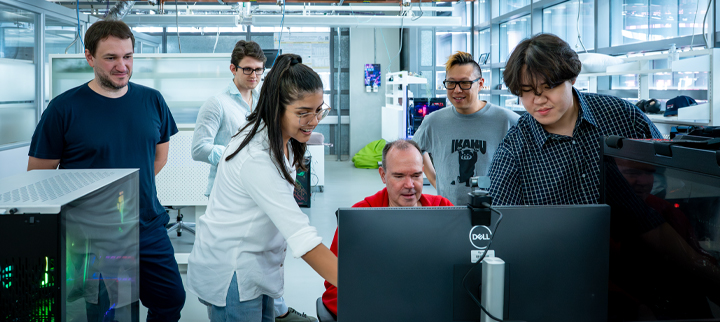
Graduates wishing to undertake their master’s in an AI specialization should be career-oriented, possess an entrepreneurial spirit, and have a desire to revolutionize industry in a leadership position. They should strive for continuous improvement, innovation, and research-based decision-making.
Except for the Master in Applied Artificial Intelligence, all M.Sc. programs offer a full scholarship including tuition, accommodation, healthcare, student visa, and a generous monthly stipend.
The Master in Applied Artificial Intelligence (MAAI) program is designed to address the critical skills gap in artificial intelligence (AI) applications within industry. Combining theoretical knowledge with practical, hands-on experience, the program equips AI or technology-related professionals working in the UAE with advanced skills for adapting and implementing AI technologies in industry, research, and government sectors.
Uses computational methods to analyze biological data, model complex biological processes, and advanced fields like genomics and personalized medicine. The department’s research focuses on applying AI to biology, with research spanning genomics, medical imaging, and epidemiology. The department will welcome its inaugural M.Sc. and Ph.D. cohorts in 2026.
Covers the foundations of computing, including algorithms, data structures, software engineering, and theoretical principles that underpin technology. The department's research advances AI-driven system design, focusing on efficient hardware, optimized LLM training, edge computing, and secure, privacy-preserving technologies.
Focuses on teaching computers to interpret and understand visual information, enabling tasks like image recognition, object detection, and video analysis. Currently ranked in the top 15 in the world, the department develops visual and vision-language AI models, focusing on robotic vision, generative media, multi-sensor fusion, and trustworthy AI.
Studies algorithms and models that enable systems to learn from data, recognize patterns, and make predictions or decisions with minimal human intervention. Currently ranked in the top 25 in the world, machine learning is our largest department. Its research focuses on adaptable, explainable AI models to tackle challenges in healthcare, energy, and smart cities.
Centers on computational techniques to analyze, understand, and generate human language, supporting applications such as chatbots, machine translation, and sentiment analysis. Currently ranked in the top 15 in the world, the department develops large language models (LLMs) with an emphasis on Arabic and underserved languages, advancing language understanding and developing applications across healthcare, finance, and education.
Explores the design and control of autonomous systems, integrating sensing, mechanical actuation, and intelligent decision-making for robots. With the Robotics Research Lab opening in 2026, the department is currently experiencing a rapid growth phase. The department develops robotic solutions for industrial automation, human assistance, and medical procedures, advancing research across environmental, social, and healthcare domains.
Employs statistical and analytical tools to extract insights from data, supporting data-driven decision-making, predictive modeling, and quantitative research. The department welcomed its inaugural M.Sc. and Ph.D. cohorts in 2025.
