
Alumni Spotlight: Can AI understand human emotions?
Thursday, April 16, 2026
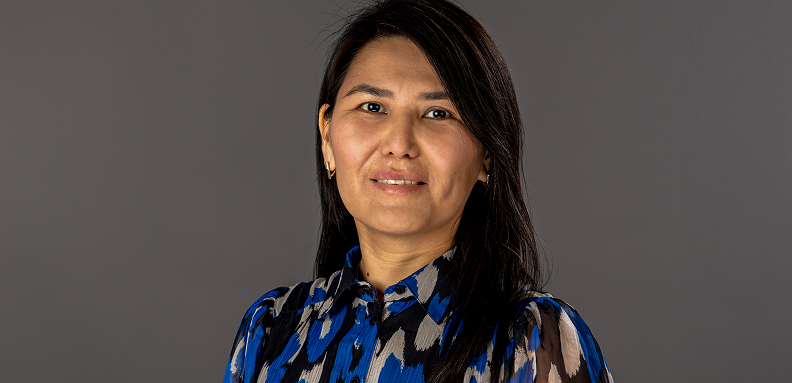
Artificial intelligence can recognize patterns in vast amounts of data. But when it comes to human emotions, even the most advanced algorithms still fall short.
For Aigerim Zhumabayeva, an alumna of the inaugural MBZUAI Class of 2022, that question sits at the center of her career and life journey. Trained in mathematics, finance, and machine learning, she now works as a psychotherapist and art therapist, advocating for mental health while exploring how technology and human intelligence intersect.
Her path has been anything but linear, yet Zhumabayeva believes every stage – from investment banking to AI research to psychotherapy – connects through one powerful concept: patterns.
“AI explores patterns in data,” she says. “Psychotherapy explores patterns in emotions and behavior.”
A journey shaped by curiosity
Originally from Kazakhstan, Zhumabayeva’s career began with a deep love of mathematics, providing the logical framework that underpins much of modern AI.
She earned a bachelor’s degree in mathematics from Lomonosov Moscow State University in Russia before focusing on finance, completing a Master of Science in Finance at the University of South Florida in the United States.
After graduating, she worked in investment banking, at the Kazakhstani sovereign wealth fund as a risk manager, and in risk validation at Credit Suisse Poland.
Her work in model risk validation exposed her to the growing role of AI in financial modeling. “As data becomes more complex, you need better tools to understand it,” she says.
Finance relies heavily on quantitative analysis. Risk modeling, financial forecasting, and investment strategies rely heavily on statistical methods and computational tools – skills that later proved valuable in her machine learning research.
“I was hearing a lot about black-box models, and I became curious about what happens under the hood,” she admits.
That led her to MBZUAI, where she completed a master’s degree in machine learning with a focus on optimization.
Real-world experience is invaluable
In finance, models work with uncertainty and decisions often depend on incomplete information. Machine learning faces similar challenges. Real-world datasets are rarely perfect. Information may be incomplete, labels may contain errors and patterns may shift over time.
Addressing those realities is essential for building trustworthy AI systems.
“My mathematics and finance backgrounds are still useful,” says Zhumabayeva, who spent two years at MBZUAI tackling a challenge in machine learning many people rarely see: noisy data.
Her thesis focused on developing methods that help machine learning systems learn effectively even when training data contains errors.
After graduation, she remained at MBZUAI as a research assistant. Today she works at the Institute of Polymodal Psychotherapy, helping clients improve their emotional wellbeing and self-awareness through creative, evidence-based approaches.
AI and emotions
One of the most pressing questions in the age of AI is whether machines can truly understand human emotions. Zhumabayeva’s answer is nuanced.
“AI can validate our feelings,” she says. “But does it understand us fully? I don’t think so.”
Large language models can generate responses that resonate with users because they draw from massive datasets of human communication. But that does not mean they possess emotional understanding.
“It is kind of mirroring us,” she says. “It has datasets from human interactions, and that’s where the mirroring comes from.”
In other words, AI reflects human behavior patterns rather than experiencing them.
For Zhumabayeva, that distinction matters. Understanding emotions requires lived experience – something machines do not yet have.
“Feelings and empathy happen through life experiences and emotional memory,” she says. “AI models don’t possess that.”
AI versus human empathy
While AI tools can provide guidance or reassurance, Zhumabayeva believes they cannot replace the human connection that defines psychotherapy.
“Psychological traumas happen in interpersonal contact,” she says. “and healing should also happen in meaningful therapeutic contact.”
Human connection allows therapists to recognize nuance, challenge harmful thinking, and provide empathy grounded in real experience. AI systems, by contrast, often prioritize user satisfaction.
“These models are optimized for client satisfaction,” she says. “They tend to agree with users.”
That tendency can become problematic if someone seeks validation for harmful behaviors or beliefs. Psychotherapists play a different role.
“We challenge people sometimes,” she adds. “We help them understand whether their behavior or intentions are healthy.”
The connection between AI and psychotherapy
Despite her transition into mental health, Zhumabayeva sees strong parallels between AI research and psychotherapy as both fields rely on pattern recognition and iterative learning.
“In AI we train models through iterations,” she says. “We tune them again and again.”
Personal growth works the same way.
“In psychotherapy, change also happens through iterations – step-by-step.”
Her background in AI also shaped her mindset as a therapist, where an inquisitive nature remains essential.
“We don’t know what’s inside every person,” she explains. “You need to stay curious.”
Art therapy: Making the invisible visible
Zhumabayeva also specializes in art therapy, a practice that uses creative expression to help people understand themselves.
Art therapy allows individuals to express and visualize emotions they may struggle to articulate. Clients might draw or create visual representations of their experiences. Therapists then guide them through questions that help uncover deeper meaning.
“We don’t interpret the artwork for them,” Zhumabayeva says. “We help them interpret it themselves.”
That process can reveal hidden emotional patterns and help individuals gain new insights.
“If there are things they don’t know about themselves,” she adds, “art therapy helps them see it.”
In her view, both AI and art therapy share a similar mission: “They both try to make the invisible visible.”
Mental health in demanding academic environments
Zhumabayeva also understands the emotional challenges students face in rigorous academic programs.
During her time at MBZUAI, she experienced a personal crisis early in her studies.
“I had my biggest meltdown during the first year,” she admits, with the transition from finance to machine learning requiring her to master new programming languages, learn complex machine-learning frameworks, and adapt to the demands of academic research.
Balancing this load with personal challenges proved difficult. But support from faculty and peers helped her persevere.
Her academic supervisor, Professor Martin Takáč, played a particularly important role.
“He had tremendous patience,” she says. “He could explain things again and again without blaming you.”
That supportive environment helped her complete her degree and later reflect on how emotional wellbeing affects learning.
“When you are stressed, you cannot comprehend information,” she says.
Today, she encourages students to build strong support systems while reminding them that struggles are part of life.
“It’s OK not to be OK,” she affirms, adding that this mindset allows people to grow while remaining true to themselves.
Exploring the future of AI and therapy
Although she now focuses on psychotherapy, Zhumabayeva continues to explore ways to integrate AI into mental health tools.
She is currently working on an idea that combines AI with art therapy programs. The concept involves gathering anonymized data from art therapy sessions – with participants’ consent – to identify patterns that could inform new digital tools.
Her goal is to develop systems that support mental health while maintaining human-centered care.
“We hope to make helpful tools that are accessible for everyone,” she says.
A human-centered philosophy
Zhumabayeva’s journey weaves mathematics, finance, AI, and psychology into a single, human-centered practice. And her perspective remains clear: AI can assist people, but it cannot replace the human experience.
Her path reflects a broader shift happening across the AI field – the recognition that solving human problems often requires interdisciplinary thinking.
“Every experience adds something,” she says, and her personal motto highlights that mindset.
“I am not weird,” she says with a smile. “I am a limited edition.”
In an age increasingly defined by AI, Zhumabayeva believes human connection remains essential. Understanding people still requires something machines do not possess.
“Empathy comes from life experience,” she concludes. “And that is something uniquely human.”
Related

A principled approach to cross-device federated learning
MBZUAI researchers have developed FedFit, a new framework for more efficient federated learning on resource-constrained devices.
- icml ,
- conference ,
- student research ,
- research ,
- machine learning ,

How AI collaboration during training can improve reasoning
Research from MBZUAI demonstrates how collaborative training enables AI models to build stronger, more diverse reasoning abilities.
- llms ,
- collaborative reasoning ,
- icml ,
- training ,
- machine learning ,
Foundational research in the age of AI
The inaugural Dean of MBZUAI's Computing and Mathematical Science Division, Éric Moulines, explains why fundamental research remains.....
- Dean ,
- research ,
- mathematics ,
- education ,
- computing ,