
AI and art: debating the future of creativity
Wednesday, May 06, 2026
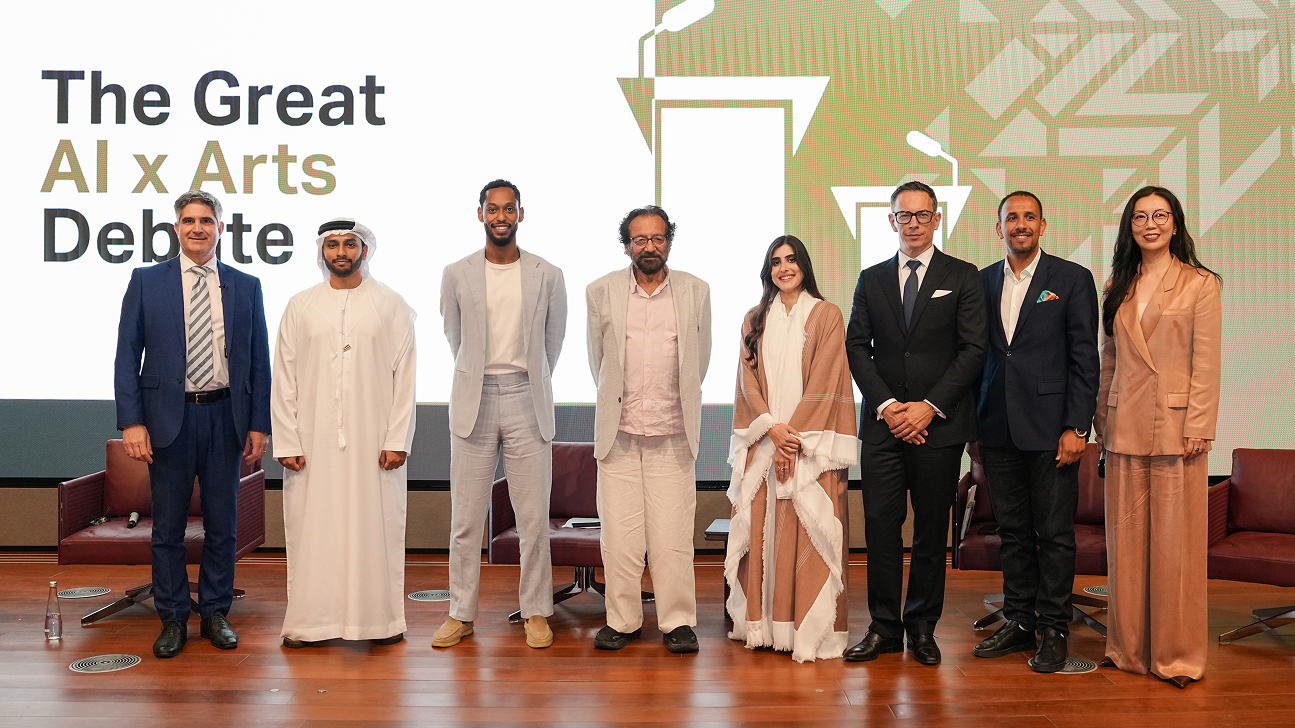
What happens to art – and to us – when machines begin to create?
That was the question at the heart of The Great AI x Arts Debate, hosted by The Academy at Zayed National Museum and bringing together artists, researchers, curators, and technologists for an evening of lively discussion at the intersection of creativity and computation.
With around 140 attendees, the event set out to explore how artificial intelligence is reshaping the meaning, making, and future of art itself. Framing the evening, Spring Fu, Managing Director of The Academy at MBZUAI, invited the audience to think beyond technology and towards something more fundamental.
“What do you think tells the story of our era?” she asked, noting that the answer shifts depending on perspective. “If you’re building or studying AI, this is an ethical question… if you’re an artist, it might be an existential question.
“This is why tonight isn’t a conversation about AI as a tool, it is a conversation about who we are when the tools are changing everything.”
The event was moderated by Abdullahi Alim, Head of Community Engagement at The Academy, and featured a panel of four speakers including Ahmed Alattar, Senior Robotics Engineer at Dubai Future Labs and an MBZUAI Art Fellow; Cesare Stefanini, Professor of Robotics at MBZUAI; Noor Almehairbi, curator at the Cultural Foundation; and Olivier Oullier, Professor of Practice in Human-Computer Interaction at MBZUAI.
Among the distinguished guests were His Excellency Saeed Al Fazari, Executive Director, Strategic Affairs at DCT Abu Dhabi, and acclaimed filmmaker Shekhar Kapur.
Defining art in the AI era
With speakers assigned positions to argue for or against – regardless of personal beliefs – the debate was designed to provoke deeper reflection, challenging both panelists and audience to think beyond their own perspectives.
The first question they were tasked with exploring was a deceptively simple one: is AI-generated art really art?
For Stefanini, the answer was cautious but optimistic. “It can be. Not by itself, but it can be,” he said, drawing parallels with earlier technological shifts. “We’ve seen this before with photography … or even electronic music. Eventually, they became powerful artistic media. Then, it’s up to the artist to put his vision and his soul into using these tools.”
He also highlighted AI’s unique potential: “What we have is an unprecedented living archive. So, the artist can ask AI things and past masters can answer.”
Alattar emphasized this historical continuity, arguing that AI belongs within a long arc of artistic evolution. “I believe that generative AI belongs to the whole continuum of art history,” he said. “We’ve seen when brushes were invented, when the camera was invented … people also questioned whether that was really art?”
For him, the essence of art lies in intention: “It’s more in the idea,” he continued. “The idea will always come from the human. Therefore, it is also art.”
Almehairbi challenged this suggestion by shifting the focus from output to process. “Art is the need to be heard, to sit in the unknown, and to make something of it,” she said. “But when AI is in the mix, you are ultimately surrendering the process to a machine. The human is there at the start and at the end, but that middle part matters, because the making is where art actually comes to fruition.”
Speaking as a neuroscientist, Oullier extended that critique into the realm of human experience. “Art is not information. It’s embodiment. It’s how we express our history as individuals,” he said. “You cannot prompt tarab [an intense state of emotion in musical or poetic performance]. You earn it. A poem is a wound that lets the light in. So far, algorithms have no wounds.”
Will AI replace the human artist?
If the first question challenged definitions of art, the second turned to its future: will AI replace or endanger the artist?
Stefanini dismissed the idea of replacement outright. “Art is not just producing images, words, or sounds. It’s about experiencing life and conveying this experience to the recipient,” he said. “Life involves feelings, struggle, emotions, and AI doesn’t live.”
For Alattar, AI represents an evolution rather than a threat. “It will not replace art or artists, it will complement them,” he argued. “Instead of just focusing on the production, now they can change their role – from producers to storytellers.”
But Almehairbi disagreed, drawing a critical distinction between the survival of art and the survival of artists as professionals. “It will not extinguish the artist, but it will damage the profession and the process behind it,” she warned. “What AI will replace is a traditional professional artist model – the working creative who relies on their practice for income.”
Oullier added that the speed and prompt-driven nature of AI risk removing an essential aspect of art: mastery. “The problem is that mastery is not something that comes like that,” he said. “Mastery takes time, effort, inspiration.”
Democratization or dilution? Who does AI art really serve?
The final question addressed access: will AI democratize art or dilute it? For Stefanini, the answer was clear. “It will actually expand access to a wider audience,” he said, pointing to applications that could make art more inclusive, including for people of determination.
Alattar agreed, describing AI as lowering barriers that have historically limited participation. “If you wanted to paint, you had to get years of training,” he said. “AI has removed a lot of obstacles for people to just jump right into the art itself.” He emphasized its impact across creators and audiences alike, from professional artists to individuals engaging with art in new ways.
Almehairbi pushed back on the assumption that access equals empowerment. “Access is not the same as democratization,” she argued. “Mass production gave everyone access, but what actually happened is that it widened the class divide.” She warned that AI could “industrialize creative output, like fast fashion,” leading to a culture of disposable art.
Oullier echoed that concern, drawing a distinction between abundance and meaning. “Yes, there is a lot more content,” he said. “But there is mass production, mass consumption … and then there is the craftsmanship of a genius.” Ultimately, he argued, “access is just the first step into art”.
Beyond the debate
Throughout the evening, live audience polling reflected the complexity of the discussion. Opinions shifted from a slight majority in favor of AI art being “true art,” to an even split on whether it threatens artists, and back toward support for its democratizing potential.
However, the debate was not about winning or resolving contradictions – it was about revealing nuances. AI can be both a tool for creativity and a force that reshapes it; a democratizing influence and a driver of new inequalities; a collaborator and a disruptor.
The event ultimately showed that AI – just like every major technological shift before it – is redefining art; as well as highlighting the importance of creating spaces where questions and concerns can be explored openly.
And as Fu suggested at the outset, the real question might not be what AI will do to art, but what it reveals about us – and what we choose to do with it.
- art ,
- conversation ,
- creativity ,
- event ,
- The Academy ,
- arts fellowship ,
- debate ,