
Commencement 2026: Finding the fun in AI code detection
Wednesday, April 29, 2026
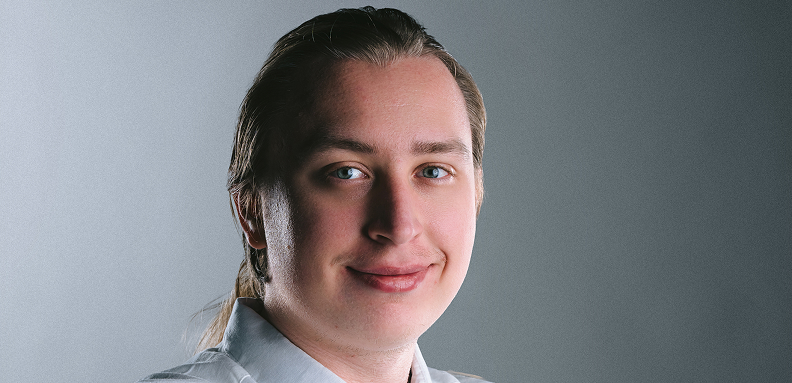
Daniil Orel was midway through judging a national AI Olympiad in his home country of Kazakhstan when something started to feel off about the students’ coding.
“While checking the submissions, I realized that a lot of them looked really weird,’ says the MBZUAI student, who will graduate with a master’s in natural language processing at the University’s Commencement 2026 ceremony on Thursday, 7 May.
“There was a very specific structure similar to what large language models generate. In the end, it was clear that I wasn’t evaluating students; I was evaluating LLMs the whole time.”
Caught between frustration and curiosity, Orel formulated a question that would go on to shape his work at MBZUAI: how can we tell what’s written by humans, and what’s written by AI?
“The problem is that this is now a huge area for cheating from the student’s side,” explains Orel. “So, I realized we probably need something to fight this. I guessed people would hate me for doing it, but this was a project I really wanted to work on.
“It was really rough and built in just over a month, but it worked. The main contribution of this work was that we introduced another direction, so we could identify hybrid code – code written by human and LLM collaboration. This work got to ACL Findings 2025, which was my first big achievement.”
The work was so interesting to Orel, that he chose to focus on AI-generated code detection for his master’s thesis at MBZUAI, which he had joined a year earlier in 2024.
The thesis combines three publications and a SemEval task (a shared task in which computational semantic analysis systems are presented and compared). Together, the three publications form a focused body of work on how we evaluate and detect AI-generated code in real-world settings.
The first establishes the core problem – that existing approaches treat authorship as a binary distinction between human and machine, overlooking the far more common scenario of collaboration between the two. The second paper introduces more robust detection methods, extending the task to account for adversarial behavior, where code is intentionally modified to obscure AI involvement. And the third shifts attention to evaluation itself, exploring how systems should be tested and compared in conditions that better reflect actual usage, rather than controlled, idealized benchmarks.
Together, the work moves from identifying a gap, to proposing practical detection methods, to rethinking how those methods are assessed – contributing to a more realistic and reliable understanding of AI-generated code as it is used in practice.
“At the beginning, it was a project that I did for fun, but it turned into something much bigger and much more interesting, which I was really happy about.”
Lending a helping hand
This idea of “fun” is a running theme for Orel when it comes to research. A natural problem-solver, he admits to finding great pleasure in getting involved with as many projects as he can – a practice that started long before his time at MBZUAI.
During his undergraduate studies at Nazarbayev University, he explored a wide range of areas, from speech technologies to astrophysics. He helped develop one of the first large-scale datasets for Kazakh speech recognition and generation, and later worked on modelling supernovas using machine learning. He also gained industry experience at Yandex, working on applied machine learning problems focused on user behavior and optimization.
That instinct to try different things led him to MBZUAI’s Undergraduate Research Internship Program (UGRIP), where he built a media profiling system capable of analyzing websites for credibility and political leaning. “It was so interesting, and for me it made my choice concrete,” he says. “I said, ‘OK, I will go to MBZUAI – it’s a cool place and I really enjoyed it there’.”
At MBZUAI, he continued to move across projects, contributing to work on Kazakh-language model Sherkala, evaluation methods, and collaborative papers such as FinChain. He also extended parts of his research through collaboration with the UKP Lab in Germany, further strengthening his work on AI-generated code detection.
“I just really like helping people and I know how to improve things because I have a little bit of experience. So, when I see something fun and interesting, I say, ‘let me help’,” he explains.
“With FinChain I realized that the approach can be improved using an approach from the time-series domain, and it worked. We improved results and got accepted to ACL Main, which is very prestigious.”
In fact, during his time at MBZUAI, Orel led or contributed to 12 papers that were accepted to conferences – including several at leading venues. A rare output for a master’s student.
He credits his supervisor, Preslav Nakov, Department Chair and Professor of Natural Language Processing, for enabling that breadth.
“As my main supervisor, Professor Preslav was helpful with everything,” he says. “He came with new ideas and suggestions, and ways to strengthen your work – he always improved what you were doing. But he was also happy for you to work with somebody else on other projects. As long as you’re productive and it helps you, then it was fine.”
Making the most of MBZUAI
Having had such a successful experience at MBZUAI, Orel is clear about the advice that he would offer incoming students.
“You have to be brave enough to submit everything to conferences, because you never know where it might lead,” he asserts. “It can be a huge gamble – even a good piece of work can get low scores – but you really have to go for it.”
He explains that one project he worked on took repeated submissions before being accepted – reinforcing his belief that persistence is key.
“Never give up on your work,” he adds. “If you’re doing it to be of benefit to others, and you want it to be noticed, then keep going and submit to the big conferences. Don’t think that you should aim low because of a lack of experience – get involved as much as you can and really go for it.”
More broadly, he sees MBZUAI as a place that shapes how people think, not just what they produce.
“It comes from the environment and the people you talk to,” he says. “It comes from how people here approach and solve problems. MBZUAI teaches you to question everything – don’t just blindly believe everything you read. Question things, analyze things, and see how you can improve or fix them. That’s the mindset you get here.”
Orel will continue to apply this mindset as a Ph.D. student at the University; potentially focusing on how models generate and understand code – a direction that builds directly on his master’s work.
His decision to stay in academia was driven by the ability to define his own problems and shift direction when needed – continuing the fun that he has enjoyed so far.
“In industry, your goals are pretty well defined, and you have to stick to that,” he explains. “That can be a good thing, but I like the flexibility of academia – the ability to be creative in your problem solving.
“Besides, I really like where things are going at MBZUAI.”
Related
MBZUAI opens the 2026-27 academic year with first cohorts in computational biology and human-computer interaction
- academic year ,
- faculty ,
- students ,

A principled approach to cross-device federated learning
MBZUAI researchers have developed FedFit, a new framework for more efficient federated learning on resource-constrained devices.
- icml ,
- conference ,
- student research ,
- research ,
- machine learning ,

Commencement 2026: Opening the black box of AI
As AI systems grow more human-like, their internal logic remains largely hidden. MBZUAI graduate Chenxi Wang is.....
Read More