
Sir Michael Brady on why healthcare AI must move from detection to articulation
Thursday, December 04, 2025
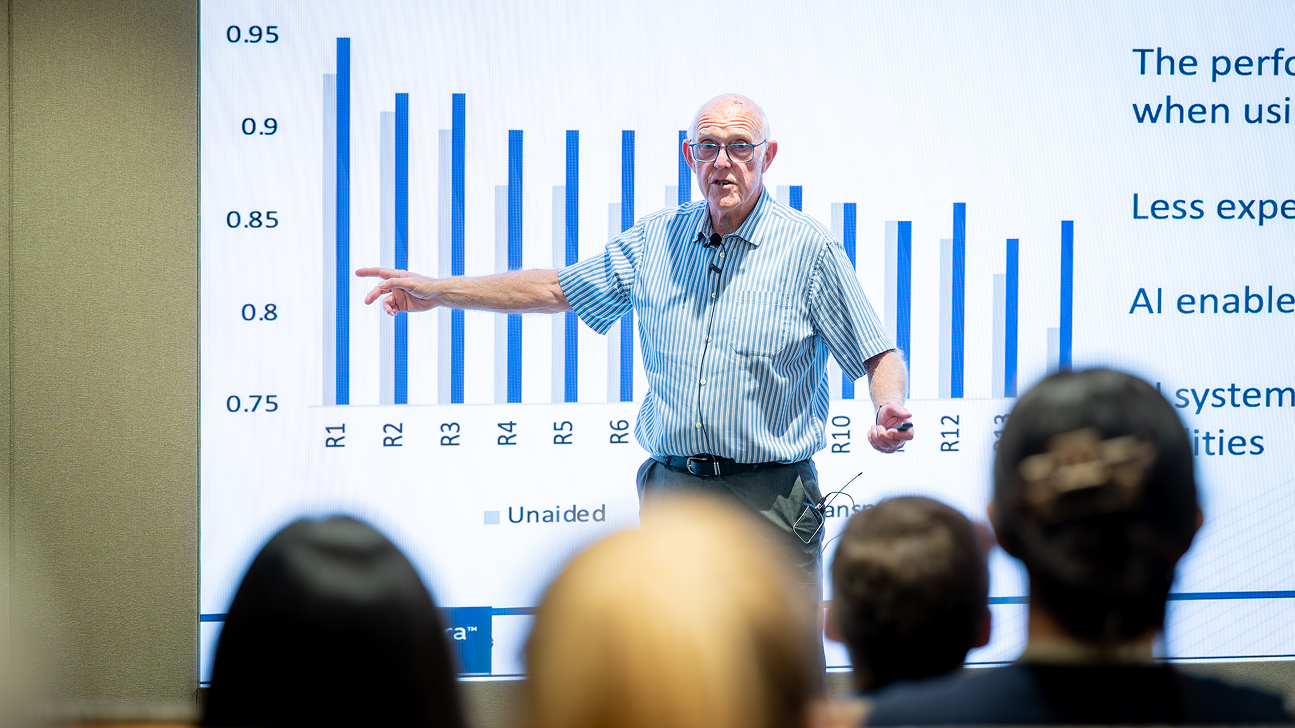
For more than four decades, Sir Michael Brady has stood at the intersection of engineering, artificial intelligence, and clinical practice.
The Emeritus Professor of Oncological Imaging in the Department of Oncology at the University of Oxford, and Distinguished Professor of Computer Vision at MBZUAI has published more than 400 papers, secured more than 40 patents, and has built a legacy of pioneering work in medical imaging. he has helped shape much of the modern field.
During a recent Distinguished Lecture at MBZUAI, Sir Michael offered candid reflections on where AI in medicine is heading, and why the next decade must move beyond pattern recognition toward true causal understanding.
At the heart of his message was a simple warning: AI will not transform healthcare unless it can explain itself to clinicians.
“You cannot simply take a neural network, a foundation model, and just tell a clinician that this patient has breast cancer,” he said. “If the clinician then comes back and asks why, you cannot simply say ‘because it scores 0.974.’ They will just stop using it.”
For Sir Michael, this it is the central barrier to the deployment of AI in many areas of healthcare. Clinicians need models that can articulate why they reached a diagnosis, why a therapy is recommended, and why a patient should be monitored in a particular way.
As such, he believes the future of medical AI hinges on causal reasoning, not just statistical pattern matching. And he sees promising work emerging in this direction, including research taking place at MBZUAI.
“There’s some great work going on here at MBZUAI on causal reasoning and Bayesian networks,” he said. “I do something like that, as well. Whether that will turn out to be the technology that takes us to that next step, I don’t know. But you’re going to have to move from detection and diagnosis of pathology to the selection of therapies and the monitoring of those therapies. Only then will we really begin to have an impact on the way medicine is practiced.”
Personalised medicine will be AI’s first major breakthrough
Sir Michael believes AI’s earliest and most immediate impact will come from helping clinicians deliver genuinely personalized medicine. Today’s clinical guidelines, he explained, are epidemiological – they represent the average person, not the individual in front of the doctor.
“AI enables us to take some of that epidemiology but apply it on an individual, personal basis,” he said. “It tells you what is relevant for Mrs. Jones, not what is relevant for all Anglo-Saxon women in the UK.
“That transformation through AI could change the way in which guidelines are represented and are deployed. I think that will maybe be one of the great contributions that AI makes to medicine.”
Among Sir Michael’s own contributions are his entrepreneurial endeavors – founding several companies for the healthcare industry. His advice to students looking to create their own AI start up? Understand that the gap between research and product can be vast.
“The first thing to realize is that there’s an enormous difference between writing a paper, even a really good paper, and getting something deployed in medicine,” he said. “There’‘s the need for regulatory clearance, for quality assurance of software, to put together not retrospective, but prospective clinical data that supports the claims that you’‘re making. Only then will you get regulatory approval. Only then will clinicians begin to think about using software.
“So I think that understanding the need for that journey, and having the humility to realize that you’ve got to work with people who know about regulatory clearances, quality assurance, and how to do prospective clinical trials is key. It’s a long way from the classroom to the clinic, but you can get there. And there are increasing numbers of people now who are showing that you can do it.”
- healthcare ,
- computer vision ,
- medicine ,
- guest lecture ,
- on campus ,
- oncology ,
- causal reasoning ,
Related
Alumni Spotlight: How Abdelrahman Shaker learned to redefine impact in AI
The MBZUAI alumnus explains how his focus has changed from papers to purpose since being awarded his.....
Read More
MBZUAI marks five years of pioneering AI excellence with anniversary ceremony and weeklong celebrations
The celebrations were held under the theme “Pioneering Tomorrow: AI, Science and Humanity,” and featured events, lectures,.....
- celebration ,
- five year anniversary ,
- ceremony ,
- event ,
- board of trustees ,
- campus ,
- faculty ,
- students ,
MBZUAI and Minerva Humanoids announce strategic research partnership to advance humanoid robotics for applications in the energy sector
The partnership will facilitate the development of next-generation humanoid robotics tailored for safety-critical industrial operations.
Read More