
From Silicon Valley to social impact through science and education
Wednesday, December 31, 2025
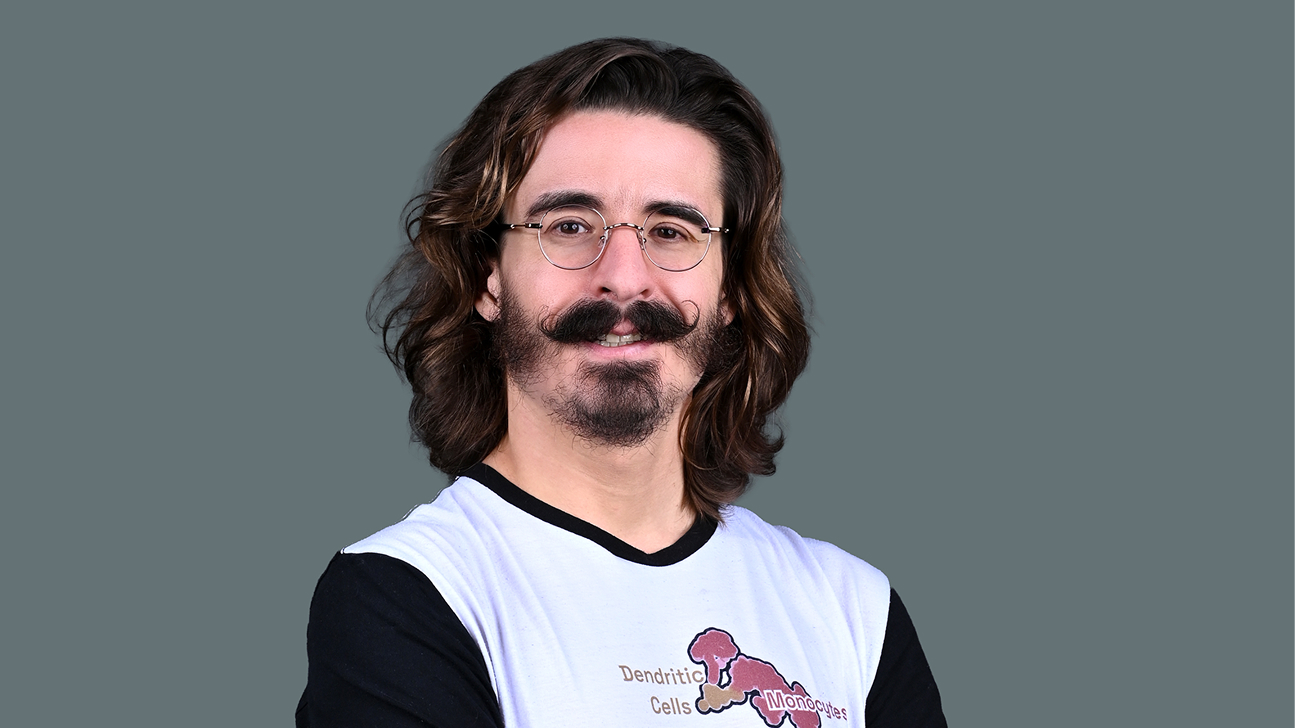
For Eduardo Beltrame, Assistant Professor of Computational Biology at Mohamed bin Zayed University of Artificial Intelligence (MBZUAI), the hardest intellectual and moral problems lie not in scientific research, but in education. Yet his career has placed him at the cutting edge of both.
At MBZUAI, Beltrame studies individual cells in the body to understand how they function and differ in health and disease. His work in single-cell RNA sequencing helps advance more precise, personalized approaches to preventing, diagnosing, and treating disease. Alongside his research, he teaches across graduate and undergraduate levels, and has played a central role in designing MBZUAI’s new master’s and Ph.D. programs in computational biology, which will launch in 2026.
Beltrame joined MBZUAI to work with Professor Eran Segal, Chair of the Department of Computational Biology and Acting Dean of the School of Digital Public Health. Segal is a globally recognized scientist whose work in computational biology, genetics, the microbiome, and personalized nutrition has reshaped multiple fields.
Together with a rapidly growing faculty, they are building a research environment intended to rival top global institutions, while retaining the agility and experimental ethos of a startup.
That ambition is reflected in the school’s research agenda, which spans foundational initiatives such as AIDO – the world’s first multiscale foundation model for biology; the Human Phenotype Project (HPP); and the analysis of vast datasets generated by nation programs such as the Emirati Genome Project.
“In single-cell biology, data has grown 100-fold in just a couple of years and will grow another order of magnitude again,” Beltrame explains. “We need new machine learning methods just to keep up with this tsunami of data. I am excited by making big conceptual, practical, and technical leaps. That’s exactly the kind of thinking MBZUAI encourages.”
For him, world-class research and thoughtful education are inseparable. “Breakthroughs happen when both science and scientists have the strongest possible foundation. Research and education go hand in hand.”
Learning how education shapes science
Beltrame’s conviction that education matters as much as – if not more than – scientific research was shaped long before joining MBZUAI. He completed his Ph.D. in Bioengineering at the California Institute of Technology (Caltech), which he describes as a “scientific paradise”. There he saw how a small, highly selective institution could empower students to cross disciplinary boundaries and pursue ambitious ideas.
After Caltech, he became founding scientist of Retro Biosciences, a Silicon Valley biotech startup backed by a landmark investment from Sam Altman.
At Retro Biosciences, Beltrame learned how quickly innovation can move when speed and iteration are prioritized. At the same time, while supporting innovative education programs in Brazil, he became increasingly convinced that education can be more consequential than any single experiment in the lab.
MBZUAI offered a rare opportunity to bring these lessons together. “MBZUAI has a startup mindset but with a serious, long-term commitment to both research and teaching,” he says. “It’s the perfect place to rethink how Computational Biology should be taught for the AI era.”
In 2025 Beltrame received MBZUAI’s Provost Award for Exemplary Service for his role in developing the new graduate programs in computational biology. At the heart of these programs is the idea that students should be able to build personalized, interdisciplinary pathways within a rigorous academic framework.
The new master’s and Ph.D. programs, starting in Fall 2026, draw on three departments within the School of Digital Public Health: Computational Biology, Epidemiology and Infectious Diseases, and Precision and Personalized Medicine.
Students begin with a strong computational biology core and then work closely with academic advisors to tailor their studies to their background and research interests. Courses are designed at the intersection of AI, biology, and public health, encouraging students to move fluidly between methods and applications.
Computational biology master’s and Ph.D. students take courses together, and undergraduates are also able to join, following a model Beltrame experienced firsthand at Caltech during his bioengineering doctorate. All students will be fully funded and free to work with any academic supervisor – giving them the opportunity to pursue projects and mentors best aligned with their goals.
“The educational goal is to train scientists who can think deeply across scientific fields and scales – from molecules and cells to populations and ecosystems,” says Beltrame. “The guiding moral principle is that our students grow to understand and respect the human implications of what they build.”
Entrepreneurship, purpose, and the undergraduate experience
Beltrame’s years in Silicon Valley also shaped how he thinks about the intersection of entrepreneurship and scientific training
“Private industry is often incredibly dynamic and well-resourced,” he reflects. “But when commercial goals are the only goals, many paths are closed: you risk losing the freedom to explore alternative possibilities and values. Many colleagues who left academia for that industry were better paid but clearly less fulfilled.”
Rather than rejecting entrepreneurship, Beltrame seeks to redefine it in educational terms. For him, entrepreneurship is fundamentally about purposeful creation – using technical tools to address real human needs. That philosophy now informs both MBZUAI’s graduate programs and its undergraduate curriculum.
With MBZUAI’s inaugural undergraduate cohort, Beltrame helped shape and teach the entrepreneurship course, drawing on the University’s startup culture and Abu Dhabi’s rapidly evolving innovation ecosystem.
Courses emphasize learning by building hands-on work with real data and rapid iteration. Students are encouraged to treat the University itself as a laboratory – testing ideas, learning from failure, and continually refining their thinking.
Discussions of entrepreneurship are grounded in questions of equity, public good, and human development, rather than market size alone.
From Brazilian favelas to global science – and back again
For Beltrame, these ideas and values are deeply personal.
Born and raised in Florianópolis, Brazil, Beltrame traces his trajectory to public and mission-driven education. The Federal Institute of Santa Catarina (IFSC), a public vocational and higher education institution, gave him the technical foundation to pursue science. Later, Brazil’s Science Without Borders scholarship enabled him to study at Brandeis University in Boston, U.S., where he encountered what he describes as an “eclectic, interdisciplinary spirit” and a strong commitment to social justice.
During the COVID-19 pandemic, Beltrame returned home. The contrasts between the abundance of resources he had seen in the U.S. and the hardships facing many Brazilians sharpened his resolve to use education as a tool for social impact.
He became involved with the Vilson Groh Institute, a long-established nonprofit in Florianópolis that supports marginalized communities through education, job training, and family assistance. There, he helped launch “Pode Crer“, a complementary education program for youth in favelas focused on technology, leadership, and civics. His role spanned curriculum design, teaching, and teacher training, alongside deeper engagement with educational research through The University of California Berkeley’s School of Education.
“Education is the hardest thing I have ever tried to study systematically,” he says. “It is participatory, contextual, and deeply human. Program design, teaching, and learning must all be understood as a single, iterative, social process.”
The success of Pode Crer, now anchored by a new Social Innovation Center being built in one of the favela communities where it started, reinforced his belief that thoughtful curriculum design can be a direct driver of social change.
Building what comes next
That conviction now informs how Beltrame and his colleagues think about computational biology, entrepreneurship, and education.
“Universities are extraordinarily complex organizations because of their triple focus on research, education, and public service,” he notes. “This complexity is even greater at MBZUAI because it is both a university and a start–up, and growing at rates that are unprecedented for most startups in any field.
“In this context, MBZUAI’s ongoing success is truly remarkable, and it is a tremendous privilege to be part of the team that is identifying directions and steering the University towards them.”
The School of Digital Public Health plans to recruit several dozen graduate students into the new computational biology programs each year, alongside continued faculty growth, and an expanding undergraduate cohort. The goal is to create an environment where top-tier faculty, ambitious research, a bold curriculum, and a value-driven entrepreneurial culture all reinforce one another.
“We now have the programs and faculty needed to offer something truly unique,” Beltrame says. “In 2026, the first students will arrive. They are the community who will add the magic and realize the full potential of what we are creating.”
Applications for the M.Sc. and Ph.D. in computational biology are open until February 27, 2026.
Related
Bridging biology and AI with domain knowledge
- statistics and data science ,
- profile ,
- data ,
- biology ,
- faculty ,
Award-winning robotic fish take deep learning below the surface
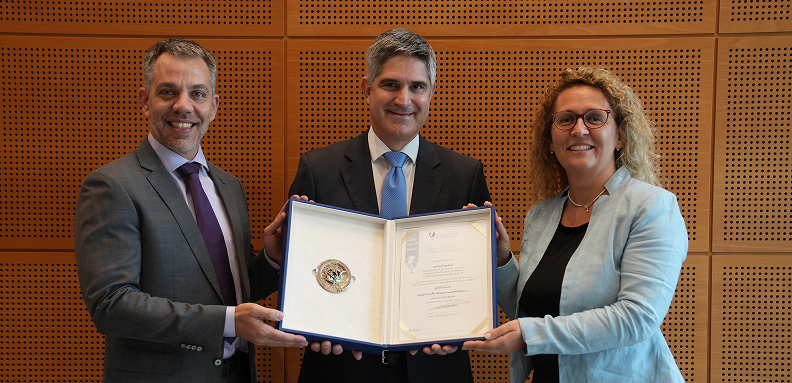
MBZUAI's Cesare Stefanini helped develop the school of underwater robots, winning the Sheikh Hamdan bin Zayed Award.....
- partnership ,
- robotics ,
- award ,
- environment ,
- marine ,
- collaboration ,

MBZUAI team awarded Google Academic Research Award to study loneliness in the age of AI
The project, led by Thamar Solorio, Monojit Choudhury, and Aseem Srivastava, will study loneliness in digital spaces.....
- social good ,
- loneliness ,
- GARA ,
- Google ,
- award ,
- nlp ,
- natural language processing ,
- research ,