
Faster, safer and smarter inspection: AI-powered robotics for industrial safety
Thursday, October 30, 2025
The challenge
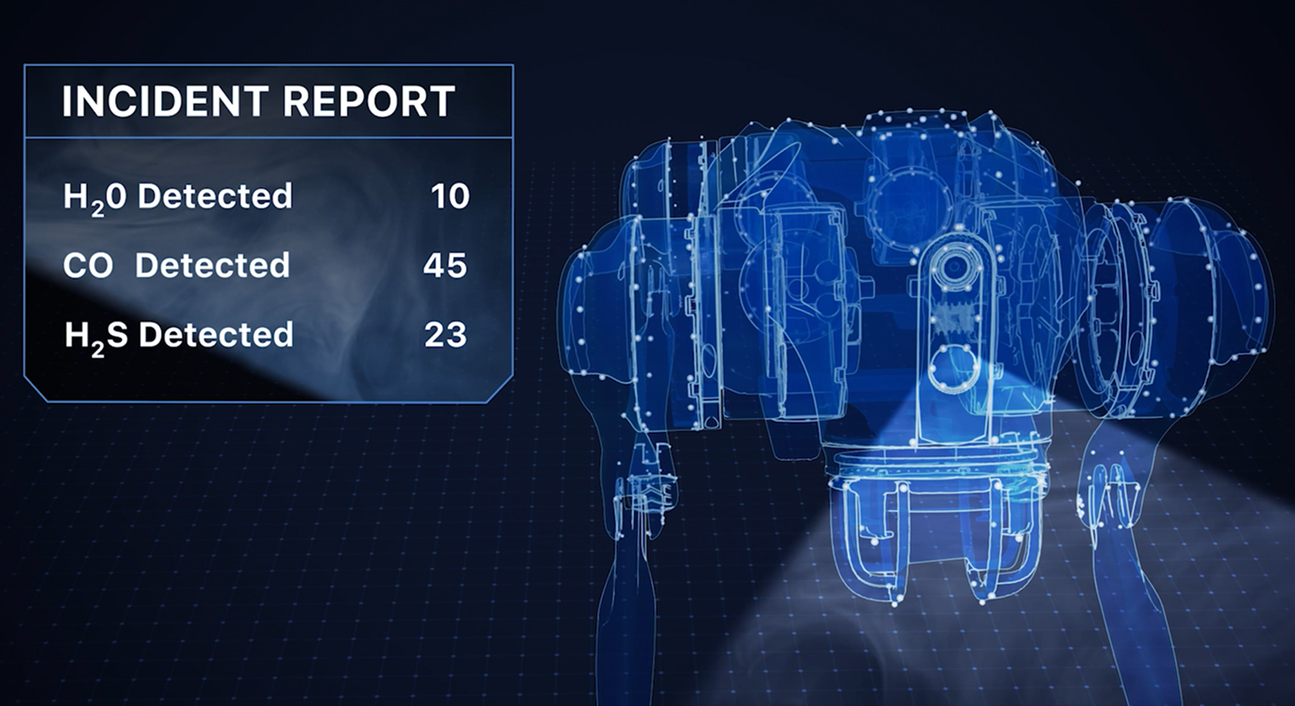
In high-risk industries such as energy, heavy manufacturing, and chemical processing, workers are often exposed to hazardous conditions caused by leaks, heat, or structural damage. These environments demand fast, complex decision-making, often under pressure and at significant personal risk.
How can organizations maintain operational safety and efficiency while minimizing danger to human workers?
MBZUAI’s solution
Researchers at MBZUAI are developing an autonomous quadruped robotic system, LAIKA, designed to enter hazardous areas, analyze complex industrial environments, and generate detailed incident reports, all without endangering human lives.
The technology integrates advanced vision-language AI models with 360-degree imaging and navigation capabilities. In operator-assist mode, a worker can use natural language to guide the robot. In full-autonomy mode, the system independently inspects, detects anomalies such as smoke or leaks, and compiles structured reports aligned with industrial safety standards.
By combining modern AI capabilities for perception, reasoning, and planning, the technology demonstrates how AI-driven robotics can enhance situational awareness and response in dangerous settings.
What makes it different
Unlike conventional inspection robots that rely on pre-programmed routines, LAIKA uses multimodal AI to interpret visual scenes and natural-language commands in real time. Its ability to learn, adapt, and self-correct makes it both versatile and scalable across industries.
“We designed LAIKA to be versatile, so that it can perform many different tasks ‘out of the box’,” says Ivan Laptev, Professor of Computer Vision at MBZUAI. “At the same time, our framework allows for correction and self-improvement if we want it to become an expert in tasks related to a particular domain.”
Faster, safer and smarter inspection
LAIKA is being positioned for deployment in industrial inspection, emergency response, and facility monitoring. In a refinery incident, for instance, the robot can locate a chemical leak and relay visual and analytical data to engineers operating safely from a distance.
Future versions of LAIKA will integrate multi-robot collaboration including humanoid robots that will autonomously resolve problems through physical interventions, and will manage large-scale facilities by collaboration and sharing data in real time across large, complex sites
LAIKA has the potential to transform industrial safety, reducing workplace injuries, operational downtime, and liability costs while increasing response speed and precision. The research aligns with MBZUAI’s vision of advancing AI for human well-being and sustainable industry.
MBZUAI invites partners in the energy, manufacturing, and safety technology sectors to collaborate in scaling AI-powered robotic solutions that safeguard workers and enable safer, smarter industrial operations.
Contact Ivan Laptev at engagement@mbzuai.ac.ae
- research ,
- innovation ,
- energy ,
- industry ,
- robotics ,
- infrastructure ,
- case study ,
- autonomous ,
Related

When disagreement becomes a signal for AI models
Research from MBZUAI and Melbourne offers new metrics and training approaches that aim to better align AI.....
- labels ,
- human judgment ,
- Computational linguistics ,
- benchmark ,
- language ,
- nlp ,
- research ,

Why AI can describe an image but struggles to understand the culture inside it
A new MBZUAI paper, accepted at EACL 2026, introduces JEEM – a benchmark for evaluating how AI.....
- image ,
- Arabic ,
- multimodal ,
- culture ,
- language ,
- EACL ,
- conference ,
- research ,
- natural language processing ,
- nlp ,
Award-winning robotic fish take deep learning below the surface
MBZUAI's Cesare Stefanini helped develop the school of underwater robots, winning the Sheikh Hamdan bin Zayed Award.....
- partnership ,
- robotics ,
- award ,
- collaboration ,
- marine ,
- environment ,