
Balancing the future of AI: MBZUAI hosts AI for the Global South workshop
Wednesday, December 10, 2025
Artificial intelligence is reshaping economies, research, and public life at remarkable speed, yet the centres of its development remain concentrated in a handful of countries, languages, and institutions.
Most of today’s leading models are trained primarily on western data, evaluated on benchmarks designed in western contexts, and influenced by western social and economic priorities.
For much of the Global South – across Asia, Africa, the Middle East, Latin America, and Oceania – this imbalance has practical consequences: tools that perform poorly on local languages, systems that misread cultural nuance, and research ecosystems without the data and compute needed to participate in frontier AI.
Against this backdrop, MBZUAI is hosting AI for the Global South (AI4GS), a three-day workshop that explores how can AI be made accessible, useful, and equally beneficial for everyone on the planet.
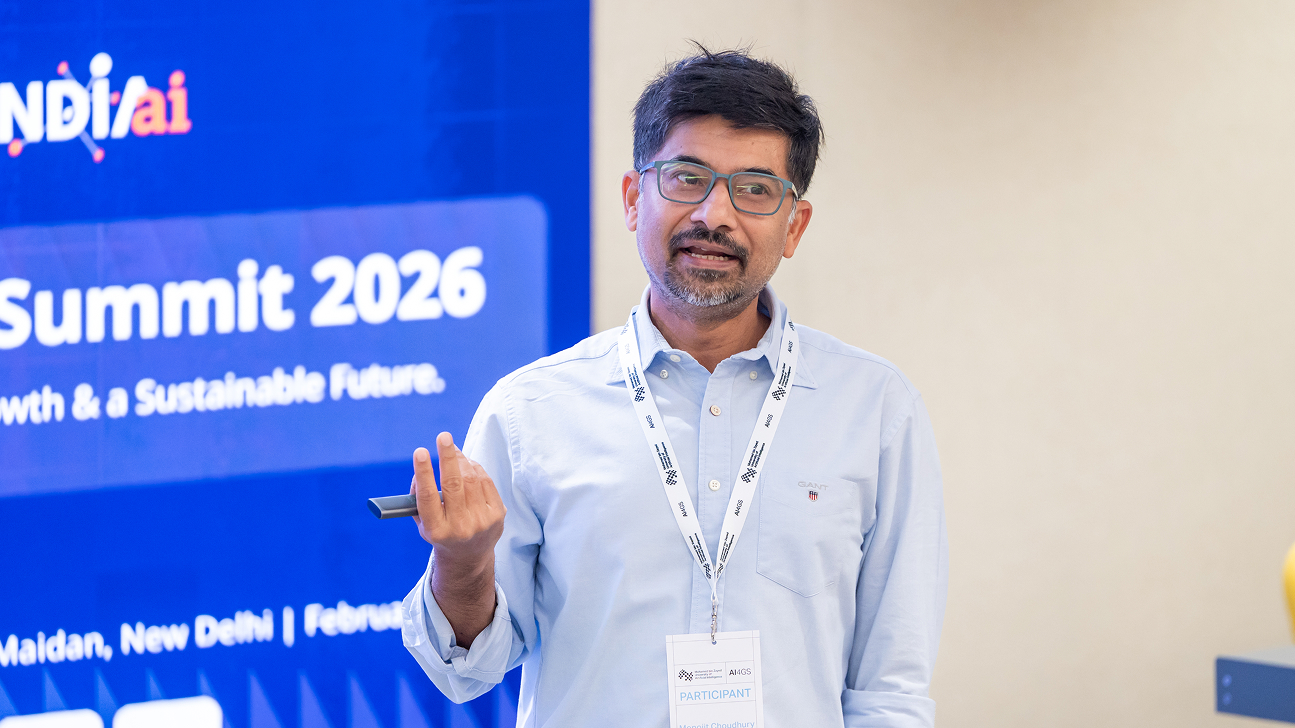
“We are calling it ‘AI for the Global South’ because the Global South is the most underrepresented in the technology space,” says Monojit Choudhury, Professor of Natural Language Processing at MBZUAI, and co-chair of AI4GS.
“But in truth, the question is broader: if AI is going to shape almost every aspect of human activity – economic, social, cultural, healthcare, education – how do we ensure that everybody is in the equation? If we don’t think about this now, we will simply miss the train.”
The event – organized between MBZUAI and the Indian Institute of Technology Delhi Abu Dhabi – is a response not to a lack of awareness, but to the fragmented way these issues are usually discussed, explains Choudhury. Economists talk about how AI will affect developing countries; AI-for-social-good communities focus on beneficial applications; NLP researchers worry about language inclusion; HCI scholars study users in specific regions; and political scientists look at AI in geopolitics and narrative-building.
“All these conversations are happening,” he says, “but they are happening in silos. We wanted to bring in people from all different disciplines so that they can talk to each other and understand the challenges and problems, and work towards the same common cause.”
The organizers deliberately invited a wide spread of participants, from researchers in NLP, computer vision, education, healthcare, energy, sustainability, and climate modelling; to specialists who study technology use in Global South communities, scholars of AI safety and alignment, economists, historians, filmmakers, and political scientists.
The geographical range is just as deliberate, with participants from Latin America, Africa, South and Southeast Asia, the Gulf and wider Middle East, as well as researchers based in North America. Alongside academics are representatives from NGOs such as the Gates Foundation; prominent technology companies including Microsoft, Google, Cohere, and G42; startups, and people who work closely with governments on policy.
The result is less a conventional conference and more a working forum, with plenary sessions to help people “see where the others are coming from,” and breakout sessions to discuss the technological, user-based, and societal aspects of AI and the Global South.
Setting the challenges of today and tomorrow
The workshop is using these conversations to identify 10–15 challenges that must be addressed over the next five to 10 years if AI is to serve everyone more equally.
“The idea is to ask: can we come up with these challenges for AI and the Global South that require planetary-scale support – from governance, from companies, from researchers, from communities – and which can guide work for the next decade?” says Choudhury.
The participants are working in groups to generate a large number of questions, which will then be refined and clustered, and finally reduced to a final selection that will be written up into a report.
Among the overrarching themes of the event are accessibility, cultural context, and languages. For example, many languages across the Global South are under-represented in datasets used to train large language models (LLMs). Even where they appear, they are often included in narrow ways that miss the richness of dialects, oral traditions, code-switching, and everyday speech.
An important part of turning the tide on this issue is to understand what the speakers of those languages really need, which Fajri Koto, Assistant Professor of Natural Language Processing at MBZUAI and Executive Member of AI4GS, will address in his talk about the national survey of language technology needs in Indonesia.
“In Indonesia, we have 700-plus languages and there are efforts to build language technology for the country and its communities,” he says. “But there are many different needs that we as researchers might not be aware of.
“Our survey seeks to understand what society really needs from language technology. Do they really need machine translation? Do they really need information retrieval or search engines? Do they really need ChatGPT-style assistants? Do they really need a speech recognition system? And among the 700 plus languages, what are the languages we should prioritize?”
Other sessions during the event tackle the problem of compute inequality, accessibility, governance, and long-term capacity building.
Why MBZUAI, and what comes next
MBZUAI’s hosting of AI4GS highlights the University’s increasingly active role in equitable, accessible, and representative AI.
Positioned between Africa and Asia, and with a vibrant multicultural society, Abu Dhabi provides a geographically and demographically relevant setting for a conversation about global inclusion.
Indeed, the University is committed to building language models for underserved languages, such as Arabic, Indian, and Kazakh through its LLMs Jais, Nanda, and Sherkala respectively.
And many of its faculty are leading experts in low-resource NLP, evaluation frameworks, sociotechnical analysis, and culturally-grounded language modelling.
“Here at MBZUAI we have a very vibrant community,” says Koto. “Most of our professors and students come from Global South communities, and I think we are in the right place to connect with both the western point of view, and the Global South point of view. So, we can bridge the knowledge we already have to help people in the Global South.”
“MBZUAI is emerging as a leader in AI, not only in this region but globally, especially in areas like large language models and foundation models,” adds Choudhury.
“We also have one of the most diverse AI communities you can find – faculty from more than 30 countries, students from around 50, and many of them from the Global South. Conversations about equity and inclusion in AI are already happening here quite naturally.”
AI4GS is also recognized as an official pre-event of the India AI Impact Summit, which will take place in February 2026 – giving the workshop’s outcomes a direct line into wider discussions about how AI is affecting societies around the world. And the organizers’ hope is that the workshop and report will become a launchpad for future collaborations.
“This report will be the ultimate reference from and for our community,” says Koto. “It will help people think of the types of projects, research or development they want to do together in the future – a trigger for future collaborations.”
They also plan to repeat the event regularly, using future meetings to ask what has been learned, what has changed, and which questions still need to be reframed.
As such, AI4GS is an important step into a wider effort to ensure that AI development becomes more representative and accessible. As AI systems move from research labs to public life, this representation and accessibility becomes increasingly vital – developing AI ecosystems that serve people across the Global South in a way most relevant and suitable to them.
- accessibility ,
- representation ,
- equitable ,
- global south ,
- AI4GS ,
- event ,
- workshop ,
- languages ,
- inclusion ,
- llms ,
- large language models ,
Related

MBZUAI team awarded Google Academic Research Award to study loneliness in the age of AI
The project, led by Thamar Solorio, Monojit Choudhury, and Aseem Srivastava, will study loneliness in digital spaces.....
- social good ,
- loneliness ,
- GARA ,
- Google ,
- award ,
- nlp ,
- research ,
- natural language processing ,

The search for an antidote to Byzantine attacks
A new study from MBZUAI and other institutions tackles malicious and faulty updates in privacy-preserving machine learning.....
Read More
UAE to deploy 8 exaflop supercomputer in India to strengthen local sovereign AI infrastructure
MBZUAI will partner with G42, Cerebras, and India’s Centre for Development of Advanced Computing to deliver the.....
- partnership ,
- summit ,
- supercomputer ,
- sovereign ,
- collaboration ,