
Alumni Spotlight: driving AI transformation at a financial giant
Wednesday, February 18, 2026
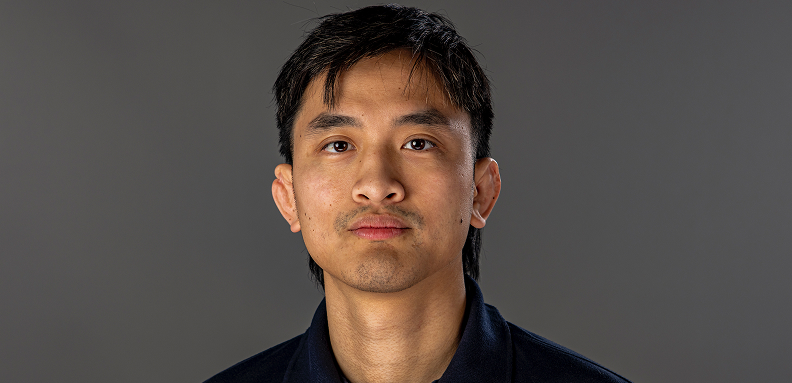
For MBZUAI alumnus Steven Hoang, studying at the Abu Dhabi-based University was a confronting experience.
“I had impostor syndrome every day,” he admits as he looks back on his two-year Master’s in Machine Learning. “But it made me a lot better. I definitely leveled up during my time there.”
‘Leveled up’ may be putting it mildly. After graduating in 2023, his talents took him to pharmaceutical research and development giant AbbVie as a natural language software developer, and later agentic AI software engineer. And in 2025 he joined U.S. financial services behemoth Wells Fargo as an AI engineer.
With such notable companies already on his CV, any sense of impostor syndrome must surely now be banished to the past.
At Wells Fargo – America’s fourth largest by total assets – Hoang is part of a team leading the company’s AI strategy. A major undertaking that he might have once felt underprepared for, but one that he now views as exciting thanks to his MBZUAI training and the scope of his work.
As well as defining how AI will sit inside the operations of one of the largest financial institutions in the country, he is also learning how to work across departments and think outside of a purely technical capacity.
“We get a lot of support from other divisions and other lines of business,” he says. “It’s really interesting to work with people from departments that I wouldn’t normally get to interact with.
“It’s really easy to get stuck into the technical aspects, but being able to take a step back and look at things from a higher level – to ask whether I’m addressing the needs of my customer personas – that’s really important.”
Diving into data
This wider perspective somewhat returns Hoang to his pre-MBZUAI years, when he worked at a marketing agency in his home state of Virginia in the United States.
“My first brush with data was Facebook ads,” he says, recalling the appeal of measuring what worked and what didn’t when taking a data-driven approach to marketing.
The book ‘Everybody Lies’ by Seth Stephens-Davidowitz deepened the fascination. “It talks about how a group of data scientists were able to scrape knowledge from the web, get all these insights, and it proved to be much more effective than qualitative approaches,” says Hoang. “I got really interested in that.”
He went on to study data science at George Mason University, which is where MBZUAI came into view. “They were bringing a lot of distinguished faculty and fully funding students’ masters, which piqued my interest. I saw that a lot of faculty were working on some really interesting areas in the field and that was the deciding factor for me.”
It was also, he admits, a chance to live outside the U.S. for the first time. Arriving in Abu Dhabi in June, he was struck first by the heat, and then by the concentration of talent.
“It felt like all my classmates were those people who sat in the front row and aced every exam,” he laughs. “MBZUAI not only taught me a lot of technical skills, but it also taught me how to learn how to do research.”
He began his studies under Martin Takáč, Associate Department Chair of Machine Learning (Education) and Associate Professor of Machine Learning, and later Hao Li, Director of the MBZUAI Metaverse Center and Professor of Computer Vision.
“[Professor Li] came in a did a presentation – talking about virtual realistic humans,” he says. “I was really interested, so I reached out and told him that I really wanted to work with him. So he brought me into his lab.”
There, Hoang worked on neural rendering – generating photorealistic humans from identity-driven data. “Given someone’s identity, you can generate an output where you have that identity but you get to drive the image,” he explains.
The project drew international attention and gave him both a sense of the frontier nature of the field, and the thrill of contributing to something new. The research also helped seed MBZUAI’s Metaverse Lab, which has gone on to explore immersive digital environments.
Beyond the classroom
Life at MBZUAI for Hoang wasn’t all research papers and code. In the then small, close-knit community of students at the Masdar City campus, he and his fellow students forged strong bonds.
“Every Friday we would always go [to a hot pot restaurant near Al Wahda Mall], which became a tradition,” he recalls. “I always looked forward to that.”
He also brought his love of martial arts to campus. “I started a boxing club at the school, and then I also trained jujitsu. The UAE is really big on jujitsu, so got a chance to check out a lot of the clubs there.”
Those experiences, both in the classroom and beyond, helped shape him not just as a researcher but as a person. So, having gone through the MBZUAI, what advice would he give incoming students?
“Talk to as many people as you can,” he says. “MBZUAI has some of the brightest minds I’ve ever seen. You never know what you might learn from a simple conversation.”
Today, as he helps one of the world’s largest banks define how AI will transform its business, that lesson rings truer than ever. The ability to learn, to collaborate across boundaries, and balance technical expertise with human insight are at the heart of MBZUAI, and have since guided his professional life.
“Being at MBZUAI taught me how to learn, how to do research, and how to push myself,” he reflects. “And it gave me memories I’ll carry for a lifetime.”
- machine learning ,
- alumni ,
- finance ,
- Alumni Spotlight ,
- student ,
Related
Alumni Spotlight: Building medical AI from the ground up
Working with hospitals across the UAE, MBZUAI alumnus Numan Saeed is helping build large medical datasets and.....
- research scientist ,
- collaboration ,
- world model ,
- Alumni Spotlight ,
- dataset ,
- alumni ,
- medicine ,
- healthcare ,
Alumni Spotlight: How Abdelrahman Shaker learned to redefine impact in AI
The MBZUAI alumnus explains how his focus has changed from papers to purpose since being awarded his.....
Read More
Alumni Spotlight: putting AI at the heart of healthcare
Driven by a personal mission, MBZUAI alumnus Ikboljon Sobirov is pursuing a Ph.D. at Oxford while working.....
- healthcare ,
- innovation ,
- medical imaging ,
- biomedical ,
- medicine ,
- Alumni Spotlight ,
- alumni ,
- Ph.D. ,