📊
Data owners
Partner to contribute and govern agricultural data responsibly.



Login
The Institute of Agriculture and Artificial Intelligence (IAAI) – launched in collaboration with the International Affairs Office at the UAE Presidential Court and the Gates Foundation is a pioneering digital advisory hub for agriculture that offers digital advisory tools, training programs, and technical assistance teams to governments, NGOs and partner organizations. The institute is dedicated to strengthening global food security, by improving the lives and livelihoods of over 43 million smallholder farmers.
The IAAI brings together global partners to build the foundational datasets and AI capabilities needed to transform frontier AI research into localized, field-ready digital advisory services – delivering timely and accurate insights into crops, soil and weather, as well as market guidance.
Through education programs and training missions, the institute helps governments, NGOs, and innovators build and deploy scalable, evidence-based, advisory tools that meet the local needs of smallholder farmers in Africa, Asia and beyond.


Smallholder farmers feed much of the world but face mounting challenges from climate shocks, market volatility, and limited access to timely information. While AI holds transformative potential, today's solutions aren't reaching these farmers at scale. The IAAI exists to bridge this divide – making AI relevant, safe, and accessible for millions of farmers across Africa and Asia.
Most AI systems are trained on data from the Global North, producing advice that's often irrelevant or incorrect for smallholder farmers in the Global South.
Many pilots exist, but there are few shared standards and no common global hub to coordinate innovation.
In-country partners lack essential data, compute resources, and AI expertise needed to build and scale solutions.
Too much AI development happens without input from real farmers and implementers who understand ground-level needs.
Through the creation of a comprehensive agricultural data corpus covering key crops, regions, and countries, we are creating a central, trusted repository of high-quality agricultural data to train AI models safely and effectively.
The institute’s core research programs will develop deployable research outputs aligned to country demands and use cases.
Through the IAAI Academy, we are training 200+ experts from ministries, NGOs, and partner organizations to support operation of AI-powered advisory systems.
We are supporting country-level pilots with dedicated technical assistance missions.

Models that use images and data to detect crop diseases and pests.
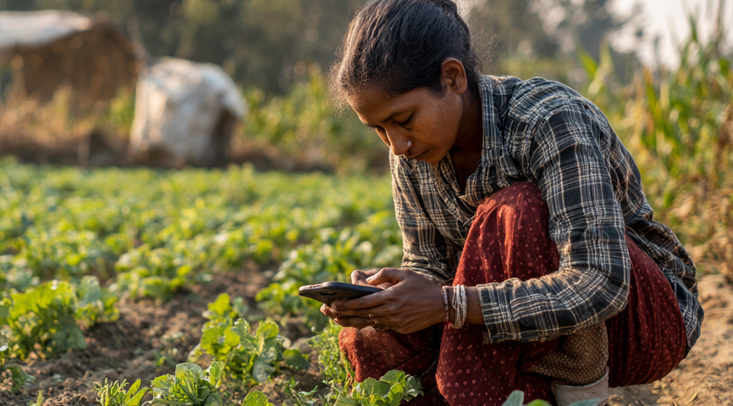
Systems that speak local languages and adapt to farmers’ literacy levels.

Large language models that incorporate real-time data and region-specific knowledge.
Models that use images and data to detect crop diseases and pests.
Systems that speak local languages and adapt to farmers’ literacy levels.
Large language models that incorporate real-time data and region-specific knowledge.
Partner to contribute and govern agricultural data responsibly.
Co-design and lead demand-driven AI research projects.
Co-create national pilots and deployment programs.
Co-invest to scale proven models across countries.
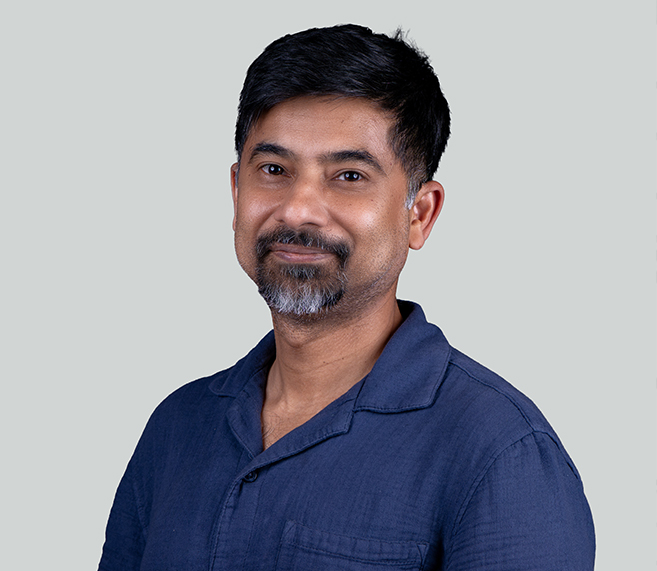
Monojit Choudhury
IAAI Chief Scientist, and Professor of Natural Language Processing
at MBZUAI

Professor Choudhury is Chief Scientist at MBZUAI's Institute for Agriculture and AI and Professor of Natural Language Processing. His research sits at the intersection of language technology and society, examining how foundation models learn - and sometimes misrepresent -$_COOKIE linguistic and cultural diversity.
A central goal of his work is to design fair, inclusive AI systems that work across languages, cultures, and economic contexts, particularly in the Global South, where data, infrastructure, and representation gaps remain significant.
Alongside his work with the IAAI, Professor Choudhury is a co-leader of MBZUAI's AI for the Global South (AI4GS) initiative, which convenes researchers, policymakers, industry leaders, and civil-society organizations to define shared research agendas for equitable AI. Through this work, he has helped shape global conversations on multilingual AI, safe and ethical data practices, and AI systems that can support real-world challenges in areas such as education, agriculture, and public services.
Before joining MBZUAI, Professor Choudhury was a Principal Researcher at Microsoft Research India and Principal Applied Scientist at Microsoft Turing. He is also Adjunct Faculty at the International Institute of Information Technology Hyderabad and Professor of Practice at Plaksha University. Beyond his research, he is deeply committed to public engagement in linguistics and AI, serving as General Chair of the Panini Linguistics Olympiad and founding co-chair of the Asia Pacific Linguistics Olympiad.
