
Beyond language: Eric Xing on the next frontier of artificial intelligence
Wednesday, April 29, 2026
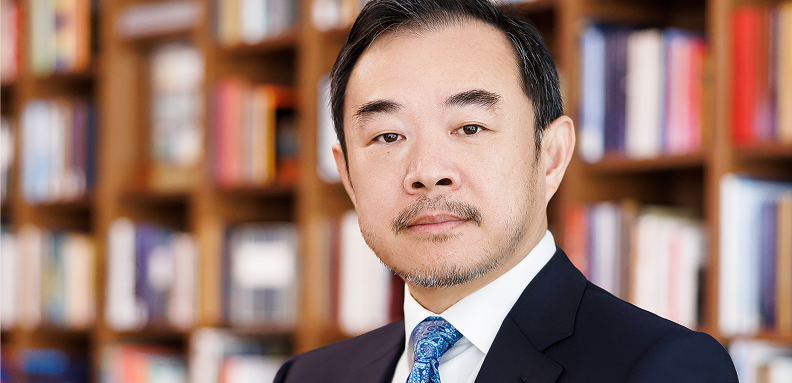
Artificial intelligence is already reshaping how we write, code, and communicate. But according to MBZUAI President and University Professor, Eric Xing, the most transformative phase of AI is only just beginning.
In a recent interview with The Washington Post, Xing outlined a shift that could redefine the field – taking us beyond today’s large language models (LLMs) towards a new generation of systems capable of simulating the real world.
These emerging systems are known as ‘world models’. Rather than predicting text based on patterns in written data, as existing AI tools do, world models aim to understand and recreate the dynamics of physical environments – opening new possibilities across science, medicine, and industry.
From “book smart” to embodied intelligence
While LLMs have achieved remarkable results – and commercial success – by learning from vast quantities of text, Xing explains that they remain constrained by the nature of that data.
“People cannot learn how to swim by reading a book. You have to basically jump into the water and start to feel it,” he told the Washington Post. “That’s called physical intelligence. Embodied intelligence [learning the rules of the world through physical intelligence] uses information – such as image or sensory data – that is outside of what an LLM is able to cover.
“That’s actually where the world model is to be defined. The world model trains on not just the text data, but also other modalities such as image, sensory signals, your audio information, your touch information and other physical environment information. The outcome is that you’re not just predicting the next token in your text; you can actually simulate how the physics of the world evolves.”
By moving from prediction to simulation, a world model can explore cause and effect –testing how systems respond to intervention and change. And one of the most compelling applications of such a change lies in biology.
Through his work at GenBio AI, where he serves as co-founder and chief scientist, Xing is helping to develop systems that can simulate cellular environments in unprecedented detail.
“A virtual cell is not just about designing a drug, but also the environment [in which] the drug needs to function,” he said.
“We don’t actually use large language models or transformers to design drugs anymore, because they are not very good at encoding or capturing this cellular context. We do in-context design by using … the world model.
“So, imagine that if you have a cell be your world. The data is not going to be just the sequence. It’s going to be sequence, structure, interaction between molecules [and] images of the localization of the molecules in the cell.”
This much more detailed representation allows researchers to move beyond isolated variables and begin modelling the full complexity of biological systems – which would accelerate the drug discovery process.
“Once you are able to digitally simulate disease and then run by different cures and drugs in a computational fashion … then drug design and treatment of diseases is going to be into a high-throughput and automated interface.
“Right now, it is still quite far, but I think the pathway or the road map has become more and more clear.”
MBZUAI at the center of a changing field
Xing’s perspective is not only evident in his own research, but also the broader direction of MBZUAI as it enters its next phase of growth.
The University is now entering a period defined by scale and impact, with a rapidly expanding student body, a growing global research network, and deepening industry collaborations – allowing MBZUAI to contribute in a deeper way to an ecosystem that extends across the UAE and beyond.
That ecosystem is underpinned by a national strategy that places AI at the core of future development. Through its research, partnerships, and talent pipeline, MBZUAI plays a key role in supporting the UAE’s ambition to be a global hub for AI innovation.
The development of world models is a major part of that future and is already taking shape at MBZUAI – not only through GenBio AI, but also PAN, an interactive, general world model capable of long-horizon simulation, developed by the University’s Institute of Foundation Models (IFM).
This ability to model cause and effect over time moves AI closer to being a tool not just for generating content, but for planning, testing, and decision-making – as seen by GenBio AI.
Through these models and others, MBZUAI is helping lead that shift – taking AI beyond language to its next phase of development.
- president office ,
- foundation models ,
- Eric Xing ,
- PAN ,
- IFM ,
- genbio ,
- world model ,
- embodied intelligence ,
Related
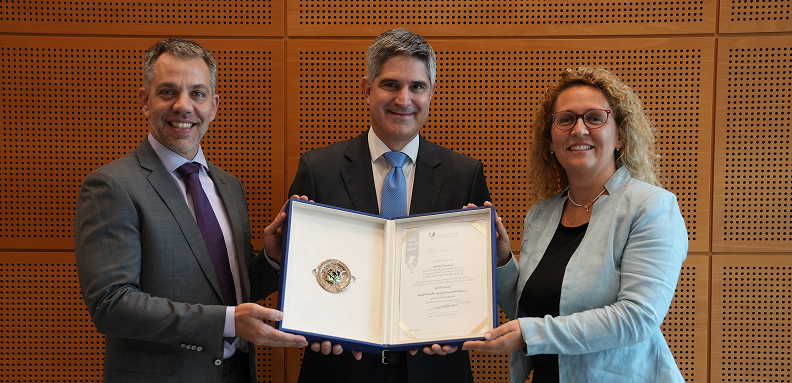
Award-winning robotic fish take deep learning below the surface
MBZUAI's Cesare Stefanini helped develop the school of underwater robots, winning the Sheikh Hamdan bin Zayed Award.....
- collaboration ,
- marine ,
- environment ,
- robotics ,
- partnership ,
- award ,

MBZUAI team awarded Google Academic Research Award to study loneliness in the age of AI
The project, led by Thamar Solorio, Monojit Choudhury, and Aseem Srivastava, will study loneliness in digital spaces.....
- social good ,
- loneliness ,
- GARA ,
- Google ,
- award ,
- nlp ,
- research ,
- natural language processing ,

UAE to deploy 8 exaflop supercomputer in India to strengthen local sovereign AI infrastructure
MBZUAI will partner with G42, Cerebras, and India’s Centre for Development of Advanced Computing to deliver the.....
- sovereign ,
- partnership ,
- summit ,
- collaboration ,
- supercomputer ,