
Alumni Spotlight: How Abdelrahman Shaker learned to redefine impact in AI
Monday, March 09, 2026
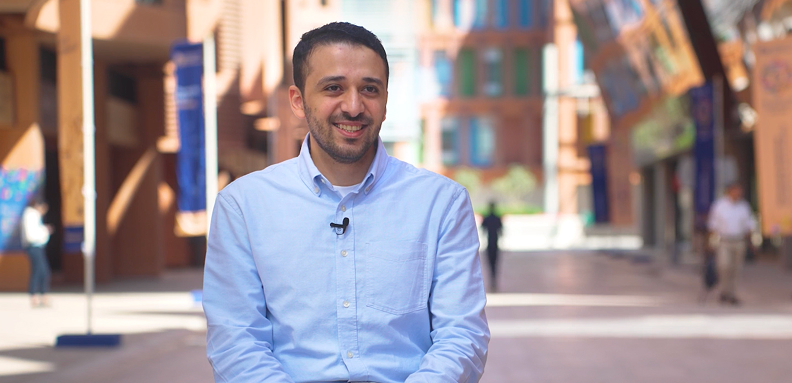
When Abdelrahman Shaker began his Ph.D. at MBZUAI, impact meant one thing: publications. Having a paper accepted at a major conference and seeing its citation count grow higher and higher was the aim of the game.
But today, as a postdoctoral researcher in the University’s Computer Vision Department, impact means something very different for Shaker.
“For me now, impact is not about visibility and number of publications. It’s about usefulness,” he says.
“In my early Ph.D. years, I was chasing publications. I wanted as many as possible to have a successful Ph.D. Over time, my perspective has shifted. I began to realize that impact doesn’t always correlate with where or how often something is published. Some of the work I least expected to matter ended up reaching far beyond academia, downloaded millions of times, forked, integrated into real-world pipelines, and deployed on actual devices.
“For example, one of my most meaningful achievements during my Ph.D. was the SwiftFormer paper (ICCV’23). SwiftFormer focuses on edge devices – developing reliable and efficient solutions for tasks such as image classification and object detection directly on mobile phones. What makes this work particularly meaningful to me is that it has been adopted by multiple third parties and deployed on real-world edge devices, reaching millions of users through practical applications.
“Another paper that has had an unexpected impact is EdgeNext. When the model was released through Hugging Face, I initially expected it to remain mostly within the research community. Over time, however, I started noticing something surprising: the download numbers kept growing, eventually surpassing five million. That growth came from people genuinely using the model, experimenting with it, and building on top of it in their own work.”
Taking a calculated risk
Shaker joined MBZUAI in 2021 as part of its second cohort – choosing the then one-year-old university over the much older University of British Columbia (UBC) in Canada, established more than 100 years earlier in 1908.
“It was a risky decision,” he admits, but one based on good reason.
“What ultimately made me choose the offer of MBZUAI over UBC’s offer was the profile of the supervisors,” he explains. “I carefully reviewed the faculty profiles of both supervisors at MBZUAI and UBC, analyzing their research directions, interests, and academic impact, and I found myself more aligned with the vision and expertise of the faculty at MBZUAI.
“Looking back at what I achieved during my Ph.D., and the journey I had, confirms that it was the correct decision. By the time I graduated in 2025, I had 10 publications with more than 2,500 citations, with impactful papers in top conferences such as CVPR, ICCV, and ECCV, and top journals including IEEE Transactions on Medical Imaging.”
The alumnus’s MBZUAI experience came after an already impressive career in academia and industry – all built on a love for computers.
“I got my first computer in 2005, and like anyone else I loved gaming, playing on the computer, and surfing the internet. I didn’t have an interest in programming at the time – it was just a love for the computer,” Shaker says.
“Later, I got my bachelor’s degree in computer science from AI Shams University in my home country, Egypt, so I started to really love computer science, programming, and machine learning. I also did my master’s in computer science at Ain Shams University, focusing on deep learning.”
In between his various degrees, Shaker worked at Mercedes-Benz as a software engineer, and automotive supplier Valeo as an algorithm engineer, as well as internships at the likes of Huawei, and automation giant ABB.
Having crossed the academia-industry divide, and back again, he has a solid perspective on the differences between the two.
“Each has its own challenges,” he says. “In industry, one of the main challenges is robustness. You might develop a solution that works well in controlled settings, but it may not be robust enough for real-world use cases. Another issue arises when a model trained on internal data is released publicly—it suddenly encounters unseen data, and you cannot fully predict how it will perform.
“You also don’t know how the system will scale. Usage could remain small, or it could grow dramatically. So in industry, the challenge is building solutions that are reliable, scalable, and robust in real-world environments.
“In academia, the challenges are different. They are more related to novelty and benchmark performance. You are expected to push the state of the art and achieve the best results on established benchmarks. That can be very demanding, but it does not necessarily require that the solution be robust enough for deployment in real-world scenarios.
“On a personal level, the pace is also very different. In industry, timelines and deadlines are critical – you need to move quickly, deliver results fast, and ensure the solution is highly accurate. That creates a strong culture of execution and proactive delivery. In academia, the pace can be more flexible. There are conference deadlines, of course, but if you miss one, there is often another opportunity later in the year.
“And finally, in academia you can choose a problem you are interested to work on. But in industry, the problem chooses you. That’s a big difference.”
From theory to real-world AI
Being party to both ways of working has helped shape Shaker’s current research direction.
“My research is related to efficient generative AI – how we can develop efficient solutions on edge devices like mobile phones without any cloud dependency, without an API [application programming interface]. This is interesting because it keeps the privacy of your phone and also improves your phone’s security. You don’t need an internet connection – everything runs on your mobile phone in your pocket.”
Eventually, Shaker aims to bring this work and all of his experience in academia and industry into his own entrepreneurial endeavor.
“I hope in five years to co-founder a company related to efficient generative AI products,” he says. “I would like to develop products like ChatGPT – LLMs on device. My interest is in multimodal, so I would like my company to develop end-to-end solutions for computer vision and language models alike – both on edge devices and mobile phones.”
In the meantime, he uses his experience of both academia and industry to offer some sage advice to current MBZUAI students.
“My first advice is not to rely on vibe coding in your research [using AI to code without understanding the underlying logic]. Instead, rely on your own thinking. You need to spend days and nights truly understanding the concepts and the research projects you are working on.
“Even if the research problem you are working on is challenging, the effort you invest in deeply understanding and solving it is always worthwhile. Just make sure you are working on something impactful and something you are genuinely passionate about. One meaningful project in your profile can shape your entire future, so you need to think beyond simply completing the requirements of your degree. It’s not about checking boxes, it’s about what you have achieved and the impact you have created.”
As MBZUAI celebrates its five-year anniversary, Shaker’s story reflects the University’s own evolution – from bold beginnings to real-world impact. For both, success is no longer measured by papers alone, but by the tangible difference those papers make.
Related

Building AI that understands the Gulf’s climate challenges
An MBZUAI team has developed Gulf Climate Agent (GCA), an AI framework designed specifically for climate decision.....
- ACL ,
- conference ,
- computer vision ,
- climate change ,
- research ,

Training multimodal AI with limited labels for a world it has never seen
A new framework from MBZUAI researchers helps AI systems remain effective when data is scarce and inputs.....
Read More
Two heads are faster than one
MBZUAI researchers have developed a new approach to video understanding that reduces computational costs while maintaining accuracy.
- research ,
- large multimodal model ,
- CVPR ,
- video ,
- conference ,